 43
43

New YSU police chief settles in
 Photo
Photo
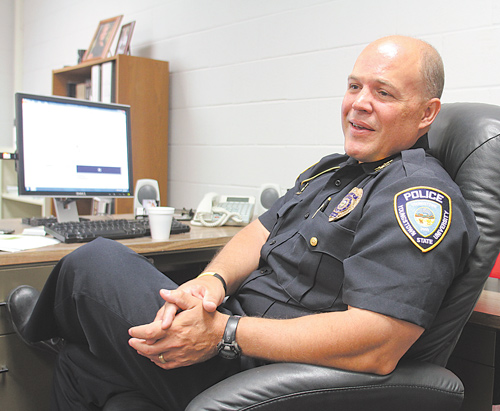
John Beshara, who was appointed Youngstown State University police chief last February, talks about some of his ideas for the university police force. Beshara, 44, a cancer survivor, plans to begin a police bicycle unit at YSU within the next few weeks.
By Denise Dick
YOUNGSTOWN
Sitting in his office at the university, new Youngstown State University police Chief John Beshara is surrounded by reminders of some of the most significant things in his life.
A whiteboard covered with red and blue writing hangs from the wall in front of his desk, detailing his ideas for the office he was appointed to last February.
Mementos from his career and education decorate the wall to his left: his bachelor’s and master’s degrees, both in criminal justice, from YSU and a yellow brick from the Marine Corps track at Quantico where Beshara, 44, of Boardman completed training at the FBI National Academy.
To his right are family photographs.
The importance of family — Julie, his wife of 21 years, and their two daughters, Taylor, 18, and Emily, 16, — crystallized for him even more the last few years.
In late 2007, they nearly lost him.
He’d just been promoted to captain at the Mahoning County Sheriff’s office where he worked for 23 years before becoming YSU chief and was feeling that things in his life were going pretty well.
One night he was working a shift as a part-time YSU police officer when his head began to pound, his vision blurred, and the room spun.
The symptoms persisted, and he sought medical attention at the Cleveland Clinic. He was diagnosed with central nervous system lymphoma, a cancer of the brain tissue.
Without treatment, he likely would have died within days. He opted for a trial treatment including chemotherapy, radiation and steroids for many weeks.
He continued to work as he was able, and he kept hitting the gym.
“I got better,” Beshara said.
The cancer has been in remission, and he’s approaching the five-year mark. He returns to the clinic every six months where doctors check him out.
“I don’t even think about it anymore,” the chief said — at least not most of the time.
“About a week before the appointments, I do start to get anxious,” Beshara said.
The experience put things in perspective.
“I realized what is most important is family,” he said.
He feels blessed that if he had to get sick, it happened at a time when effective treatment was available. A few years before, and he may not have been as fortunate.
Since becoming chief after the retirement of long-time chief John Gocala, Beshara has been restructuring the YSU department.
At the time of his appointment to the $85,000-a-year job, YSU President Cynthia E. Anderson said, “As a YSU graduate and a lifelong resident of Mahoning County, Capt. Beshara is committed to making the university and the surrounding community a safe place to learn and live.”
Beshara reduced the roles of the intermittent, or part-time, police force from 100 to about 75, by removing officers who hadn’t worked for the department for years.
He’s hoping to rebuild that force, officers used for details during campus sports and other events, using a combination of veteran officers from other departments and recent police-academy graduates.
Law enforcement can be a difficult field to break into, and Beshara believes that giving young officers a foot in the door may help them gain experience and full-time employment.
He’s starting a bike unit within the next few weeks. The campus is ideal for such a unit because bicycles can go places that cars can’t. Bikes also lend themselves well to community policing, a concept Beshara supports.
“An officer is much more approachable on a bike than in a car,” he said.
The new chief believes the department is there to serve university students, staff and visitors, and the bike unit fits with that mission.
Another change Beshara implemented involves promotions approved by the university administration.
Lt. Mike Cretella, a 30-year department veteran, will be promoted to deputy chief, the department’s second in command.
Three sergeants will be promoted to lieutenant — one to oversee administration, one operations and one investigations. Cretella was the only lieutenant, and the department had seven sergeants. At times, there was more than one sergeant on duty per shift so it was unclear who was in charge.
Beshara said the change should remedy that.
At one time, the department staffed three lieutenants but it dwindled to just Cretella, and he was stretched thin trying to juggle duties, the chief said.
Beshara said he has a passion for his work, loves his job, and he doesn’t sweat the small stuff.
“Life is delicate,” he said. “I never wake up angry or go to bed angry. I don’t have time for that. Life is too short.”