 43
43

Open for business
 Photo
Photo
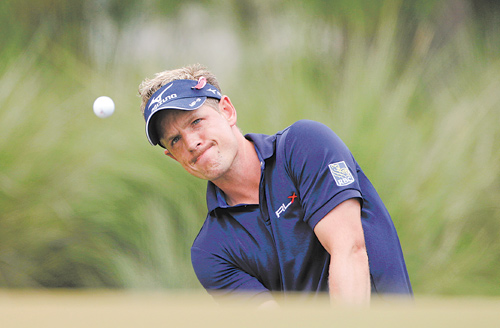
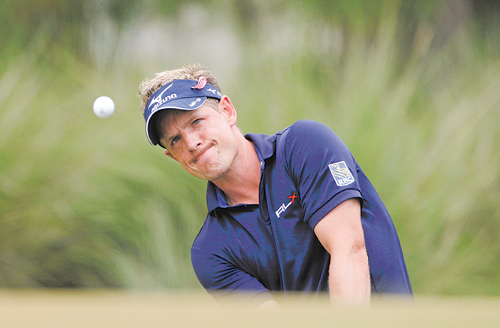
England’s Luke Donald, the world’s No. 1-ranked golfer, will try to win his first major championship this weekend at the U.S. Open at the Olympic Club in San Francisco. It is the fifth time the club will play host for the tournament.
A brutal opening six holes, tight fairways, huge rough and small greens will make for a difficult test at Olympic
Associated Press
SAN FRANCISCO
Rod Pampling actually used the words “enjoyable” and “U.S. Open” in the same sentence.
Then again, it was Sunday before the toughest test in golf gets under way at The Olympic Club.
Pampling was among a few dozen players who took advantage of abundant sunshine and little stress at Olympic on the final day before the gates open to the second major championship of the year.
“At this stage, on a calm day, it is enjoyable,” Pampling said.
Behind him on the course were Luke Donald and Keegan Bradley, who played a match that went to the 18th hole. Donald is No. 1 in the world and trying to win his first major.
Also on the course was Graeme McDowell, who won the last time the U.S. Open came to northern California, at Pebble Beach two years ago.
The Olympic Club is hosting the U.S. Open for the fifth time, and there might not be any surprises on the golf course — the players expect it to be hard.
“It’s a typical U.S. Open — small greens, tight fairways,” Hunter Mahan said. “You’re going to have to put the ball in play. You can’t just hit it anywhere and score. This is going to be more about where your misses are than where your good shots are.”
One difference between Olympic now and in 1998, the last year it held the U.S. Open, is the par.
The 520-yard opening hole is now a par 4, while the 522-yard 17th hole has been converted to a par 5. The change makes the opening six holes one of the toughest stretches anywhere in golf.
“What’s unique about this year is that you’ve got the first six holes that are beyond brutal,” USGA executive director Mike Davis said. “They’re going to walk to the seventh tee and be 2 or 3 over and think, ‘I’ve got to catch up,’ when in reality, they don’t.”
Donald played them a couple over par on Sunday, which might actually be par for the course.
“That start of this golf course ... you could be 5 over in five holes and not be that far off,” Kevin Chappell said.
The finish can be on the softer side.
The players don’t see a par 5 until No. 16, and it’s the longest hole (670 yards) in U.S. Open history. It is followed by another par 5 that can be reached in two, and then ends with a 344-yard 18th with a fairway that looks not much wider than a country road. Even so, players could hit wedges into the green on the last five holes depending on the pin placements and conditions.
“It’s not the most intimidating U.S. Open finish ever,” McDowell said. “I’d give my left arm for a one-shot lead playing the 17th. You’d fancy your chances. It’s not like trying to close it out at Oakmont or Winged Foot, where you’re really trying to get the job done.”
But he was not suggesting it would be easy, either.
The green on the par-5 17th is the most severe at Olympic Club. Pampling’s caddie, Kevin Fasbender, tossed a ball toward the right one-third of the green and watched it trickle to the right until it ran down the slope and some 15 yards away in a collection area.
On the 18th, McDowell was on the right side of the fairway and hit his wedge slightly to the right of the flag. It caught a cypress tree and dropped down into some of the nastiest rough on the course.
“Someone will make a real mess of 18. I’m predicting that right now,” McDowell said.
And for the 16th?
“I’ve never played a hole that long in my life,” Bradley said.
And the hardest part of this U.S. Open?
Walking up a steep, massive hill toward the clubhouse. As if Olympic were not hard enough already.