 43
43

Valley viewers miss out on Transit of Venus
 Photo
Photo
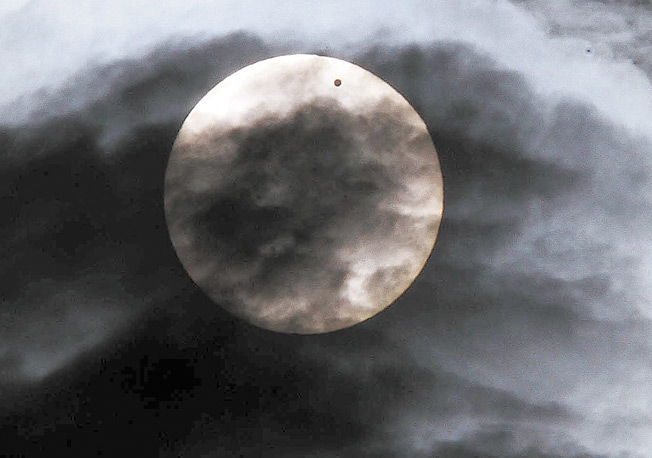
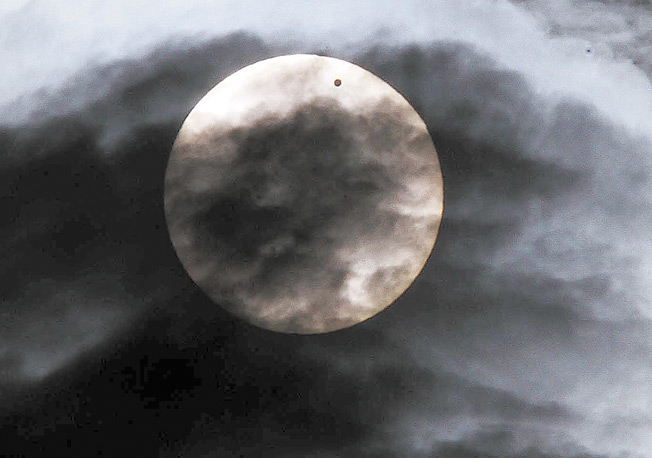
The Transit of Venus in front of the sun is seen from Cape May Point, N.J., on Tuesday. From the U.S. to South Korea, people around the world turned their attention to the daytime sky Tuesday and early today to make sure they caught the once-in-a-lifetime sight of the Transit of Venus, which won’t be seen for another 105 years.
By PETER H. MILLIKEN
milliken@vindy.com
CANFIELD
Area residents hoping to see the rare Transit of Venus across the face of the sun through filtered telescopes at Mill Creek MetroParks Farm early Tuesday evening were disappointed because the sun was obscured by clouds.
However, a Youngstown State University faculty member said the silver lining in the clouds was that the transit gave him and other members of the university’s planetarium staff a chance to educate the public about the universe.
“We always hope that people are going to come out and not only see the transit, like we hoped that they would, but to learn about the transit” and other aspects of the solar system, said Dr. Patrick Durrell, associate professor of physics and astronomy and planetarium director.
The only people who saw the transit at the farm were those who watched it live on the Internet on their smartphones as seen from telescopes located where the sun wasn’t hidden behind clouds.
Unfortunately, the Transit of Venus won’t be repeated until 2117.
Had the clouds not interfered, the Tuesday viewing at the farm would have been facilitated by filtered telescopes set by YSU’s Ward-Beecher Planetarium staff and members of the Mahoning Valley Astronomical Society.
Some 200 people gathered at the farm by the 6 p.m. start of the transit, but most of them left within an hour after it became clear that any unobstructed view of the sun would be unlikely.
During a transit, Venus passes directly between the earth and the sun and appears as a small black dot crossing the face of the sun. Venus and Earth are about the same size.
The viewing period here would have been from 6 p.m. until sundown, but cloud-free areas in and around the Pacific Ocean got a full view of the transit throughout its 6-hour-and-40-minute duration.
The transits occur in pairs, about eight years apart, with each pair separated by more than a century. Previous pairs of transits were in the years 1518 and 1526, 1631 and 1639, 1761 and 1769, and 1874 and 1882.
The end of the last previous Transit of Venus was visible here just after sunrise June 8, 2004.
Ann Kurz of Canfield, who was at the farm Tuesday evening, recalled going to the Mahoning County Career and Technical Center, where she saw an unobstructed view of the 2004 transit through a YSU telescope with about three dozen other people.
“That was truly awesome. ... We watched it through a filtered telescope, and we were able to actually see the little black dot of Venus moving across the sun,” she said.
The next pair of transits will be on Dec. 10 and 11, 2117, and Dec. 8, 2125.
Eighteenth Century astronomers timed the Transits of Venus and used trigonometry to calculate the distance between the earth and the sun and came within 3 percent of the actual distance, now known to average 93 million miles.
Venus orbits the sun every 225 Earth days at an average distance of 67 million miles from the sun.