 43
43

Monitoring agency sniffs out Mahoning-Trumbull pollution
 Photo
Photo
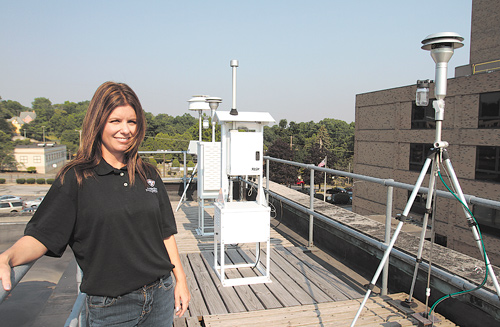
Administrator Tara Cioffi of the Mahoning-Trumbull Air Pollution Control Agency checks the air-quality monitoring equipment on the roof of the building next to Oakhill Renaissance Place at 345 Oak Hill Ave. in Youngstown.
YOUNGSTOWN
A tiny agency tucked inside Oakhill Renaissance Place serves as an air- quality watchdog for Mahoning and Trumbull counties, and its work is most noted during summer ozone alert days.
Founded 40 years ago, shortly after the start of the environmental regulation movement, the Mahoning-Trumbull Air Pollution Control Agency monitors and enforces air quality in the two counties.
With a staff consisting of six Youngstown city employees, M-TAPCA has 19 air quality monitors at various locations in Mahoning and Trumbull counties. Its offices are housed in, and part of, the city health department, which is a tenant in the Mahoning County-owned Oak-hill office complex at 345 Oak Hill Ave.
The air-quality agency has an annual budget of about $350,000, of which $68,000 comes from the city and the remainder from the U.S. and Ohio environmental protection agencies.
As one of nine local air-quality monitoring agencies in Ohio, it monitors and reports to the Ohio EPA its findings for air pollutants, including particulates (ash and soot particles), sulphur dioxide (a gas produced by coal and oil burning), lead and ozone.
“We’re meeting all of the national air-quality standards,” Tara Cioffi, M-TAPCA administrator, said of the Mahoning Valley.
However, the major ongoing air-pollution concern in the Mahoning Valley is ground-level ozone on hot and sunny days, with several ozone alert days already having been declared this year.
Between April 1 and Oct. 31, the agency continuously operates ozone monitors at its office at Oakhill Renaissance Place in Youngstown and in Vienna and Kinsman.
Volatile organic compounds and nitrogen oxides produced by gasoline vapors, chemical solvents and industrial and motor-vehicle emissions react in the presence of sunlight to produce ozone.
Breathing the ground-level ozone can trigger throat irritation, coughing and congestion and worsen bronchitis, asthma and emphysema, according to the U.S. EPA.
On days when the Ohio EPA issues ozone alerts, Cioffi advises that young children and the elderly and “anybody more susceptible to respiratory disease” and those with lung disease stay in an indoor, air-conditioned place.
To reduce ground-level ozone on alert days, she advised people to avoid fueling vehicles or mowing lawns. If they must engage in these activities on those days, she urged doing so after 7 p.m., when sunlight is less intense.
In general, the Mahoning Valley’s air quality has improved in recent decades because of the closings of the major steel mills here in the late 1970s and early 1980s, because the local population has dropped, and because remaining industries have reduced air-pollutant emissions in accordance with environmental regulations, Cioffi said.
Erin Bishop, acting city health commissioner, said she’s glad to have the local air-quality agency within her department.
“It’s an integral part of our health department. ... It’s an important part of public health,” Bishop said. “They’re right here on site. We don’t need to call Columbus or call Cleveland” to attend to local air-quality issues, she added.
“It’s been here for 40 years, and we hope to have it here 40 more,” Bishop said of the air-quality monitoring agency here.
“We’re a local representative of the Ohio EPA,” Cioffi said. “We’re here. We can monitor the air more closely” and monitor local industries to ensure their compliance with clean air standards, she added.
Most recently, Cioffi said she has consulted with city Law Director Anthony Farris and Fire Chief John O’Neill concerning a series of fires at the former RRI tire recycling plant on Brittain Street, where she said burning tires have generated “a mixture of toxic gases that could definitely cause respiratory problems.”
The majority of approximately 14,000 tires at that location burned up in the fires, Cioffi said.
Cioffi said she has visited and observed the Brittain Street plant since the fires to evaluate strategies for its demolition in accordance with air-quality regulations.
The city is working with the Ohio EPA concerning removal and proper disposal of the remaining tires, Cioffi said.
Staff members of the local air-quality agency regularly visit demolition sites to ensure that asbestos has been properly removed and that contractors are hosing down the demolition sites continuously with water to reduce dust while they are working.
Agency staff also respond to open-burning complaints, Bishop said.