 43
43

Bunches of biscuits
 Photo
Photo
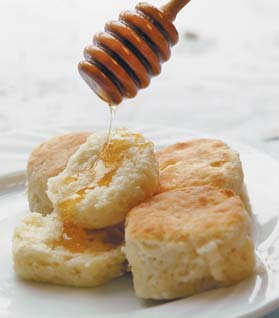
Callie’s Charleston Biscuits are shown with a drizzle of honey.
By Judith Evans
St. Louis Post-Dispatch
CHARLESTON, S.C.
Watching Lauren Vinciguerra make biscuits is poetry in motion.
She pours, mixes, rolls and shapes with sureness and efficiency. When she’s done, just a few minutes after she started, five pounds of flour, a pound of butter, a pound and a half of cream cheese and a half-gallon of buttermilk have been transformed into 126 biscuits filling a sheet pan, ready to go into the oven.
As manager of Callie’s Charleston Biscuits, Vinciguerra is used to baking in quantity. Her bakery makes about 80,000 biscuits a month, all by hand. “That’s our forte,” she says.
Nathalie Dupree takes a different tack. Her recipes make enough biscuits to mound in a bread basket, not to make a mountain. Instead of buttermilk, she mixes cream and plain yogurt.
“The reality is, most people have yogurt in the house more than they have buttermilk,” says Dupree, author with Cynthia Graubart of the new cookbook “Southern Biscuits” (Gibbs Smith, $21.99).
Despite the differences, they both make biscuits more by feel than by measure. And both generously shared their hints and techniques recently at a demonstration for food journalists in Charleston, S.C.
So whether you’re making a large batch or just a few, here are tips to turn out light, tasty biscuits.
Most recipes call for cold butter, but Vinciguerra lets it come to room temperature before rubbing it into the flour. Soft butter is easier on your hands, and the biscuits won’t suffer.
Vinciguerra’s biscuit dough is studded with chunks of cream cheese the size of small peas. “We call this a little insurance — you bite into the biscuit and there’s a little bit of love: the cream cheese.”
Both bakers recommend using a mixing bowl that’s wider than it is deep.
Use your hands to mix the flour-butter mixture into the liquid ingredients. “You stir around, making an eddy, adding more flour as you need it,” Dupree says.
Dough “wet like lava” makes the lightest biscuits, Dupree says.
When you’re ready to clean the dough off your hands, rub them with dry flour. “You don’t want to put water on them — they’ll get sticky,” Vinciguerra says.
Vinciguerra uses unbleached flour, a requirement of Whole Foods, which sells Callie’s Charleston Biscuits. (They’re also available by mail order from calliesbiscuits.com.) Dupree uses bleached flour because the biscuits bake up whiter. Both use White Lily self-rising flour, which has a lower protein content.
Dupree doesn’t sift flour. “That’s a nuisance. I simply take a whisk or a fork and lightly go through it.” Stir lightly, however, or you will over-aerate the flour. Spoon the stirred flour from the bag or canister into a dry measuring cup, and level off the top with a straight edge.
Most recipes instruct bakers to cut the butter or other fat into the flour when combining them. “My motion is a snap,” Dupree says. “Cut is a terrible word if you’re a literalist — like my husband — who would get a scissors.”
Copyright 2012 Associated Press. All rights reserved. This material may not be published, broadcast, rewritten, or redistributed.