 43
43

Girard waste-plant workers hold noses, rake in big bucks
 Photo
Photo
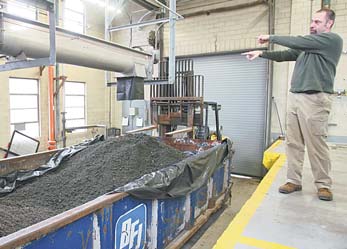
Howard Zickefoose, acting superintendent of the Girard waste-water treatment plant, shows the final processed waste product to be sent to a landfill. The new equipment is expected to generate about $180,000 in additional revenue for Girard annually.
Girard
It smells bad, but it means good things for the city’s budget.
The “it” is the waste that comes into the city’s wastetreatment plant.
When waste comes into the plant, it sits in a large tank called a digester.
There the methane that comes from the waste is combined with natural gas to heat the sludge. It repeats the process in a second tank before being mixed with chemicals and pumped through a filter press.
After the last bit of liquid is pressed from the sludge, the press empties the dry remains, now black and clumpy, into a 20-yard hopper to be eventually hauled off to dumps.
Although the smell from that hopper lingers in the plant’s hallways and sticks to the employees’ clothing, the treating of the waste means big money for the city.
Thanks to the V&M Star expansion, treating the pungent waste is expected to bring in an additional $180,000 a year to the city, for treating the gallons of waste the steel-tube manufacturing company will produce during its 24-hour operation.
But none of that would be possible had it not been for the purchase of a new filter press, a 17-foot long, 10-foot high machine of layered semi-permeable conveyor belts and rolling pins.
“It was perfect timing,” said Howard Zickefoose, the acting superintendent of the treatment plant.
He said before 2010 when the half-refurbished, half-new press was constructed in the back room of the plant’s main building, there used to be two presses. Zickefoose said one of them didn’t run at all while the other was on the fritz almost constantly. Parts for the 30-year-old presses were no longer made, forcing workers to fix broken components on their own.
During discussions on the V&M expansion, there was concern whether Girard’s treatment plant, with its one-working press, could handle the permitted 200,000 gallons of waste coming from the company each day.
“It would have been too much on our system,” Zickefoose said.
But the purchase of the $318,000 press, which was more than paid for by Youngstown as part of a cooperative agreement for handling V&M’s expansion, made it possible to treat that volume of waste.
Zickefoose, who has been with the city’s treatment plant for 25 years, remembers the old press. Essentially, he explained while standing over the new press, it would take the old press two weeks to do the work the new one does in five to eight hours.
He said the new press can operate without constant attention, allowing the one employee that used to supervise the old presses to tackle other matters in the warehouse.
Dennis Meek, an engineer for the city for the past 12 years, helped design the press’ layout within the room. He said over the span of three months in 2010, the press’ parts were shipped to Girard and constructed by local contractors.
For an engineer who has overseen more than his fair share of press installations, Meek sees the press as a piece of art.
“I have a strange sense of art,” he admitted.
As for the smell, both he and Zickefoose said, you eventually get used to it.