 43
43

Networking wonders
 Photo
Photo
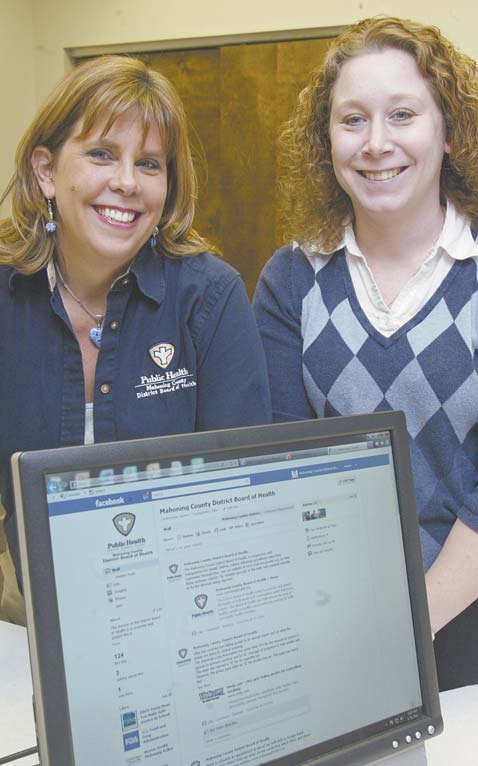
Tracy Styka, left, and Susan Kovach of the Mahoning County District Board of Health with the Facebook page they created to help inform the public in the event of a health emergency.
YOUNGSTOWN
Social-media channels — Facebook, Twitter and others — have become business tools for nonprofits, enabling them to connect with their clientele quickly, cheaply and intimately.
And, in turn, those who seek services from hospitals, service agencies and other groups use social media to connect with others in their lives.
When Sarah and Christopher Plant’s daughter Rebekah was born last November, doctors at ValleyCare Trumbull Memorial Hospital in Warren discovered she had a congenital heart defect.
Rebekah was transferred to Akron Children’s Hospital in Akron, where she spent 10 weeks in the neonatal intensive-care unit recovering from surgery before coming home to Mineral Ridge.
Sarah and Christopher kept family and friends updated on Rebekah’s condition using a “mommy blog” developed by Akron Children’s Hospital.
“It’s easier than trying to phone or write email letters, and we can control the information,” said Sarah, a former English teacher.
Social media is the new information highway for area nonprofit organizations and their clients. They use it to monitor their competition, post jobs and recruit employees, and publish program and event information.
Though some groups are cautiously dipping their toes into the social-media pool for the first time, others have been at it full bore for years.
“Our primary reason for developing social-media capability is the need to reach specific audiences quickly in the event of a public health emergency,” said Tracy Styka, community health education specialist with the Mahoning County District Board of Health.
A worst-case scenario would be a cataclysmic event such as a bioterrorism anthrax attack in which medications would have to be dispensed within 48 hours to everyone in Mahoning County, said Susan Kovach, also a community health education specialist for the county health department.
The county health department uses a telephone and email program, NotifyNow, to communicate with key partners such as agencies, hospitals, schools and businesses, who in turn communicate with their populations as part of the emergency-response plan, Styka said.
Facebook provides another way for county residents to learn about public-health programs and events, Styka said.
The Trumbull County Mental Health and Recovery Board’s Alliance for Substance Prevention has used Facebook for about three years but recently has begun making more use of it, said Lauren Thorp, Alliance coordinator.
“Facebook is a good tool to get information out to alliance members and to reach young people and the community.” Thorp said. “The majority of alliance members and the population we want to reach use Facebook.”
She said she turned over Facebook to a younger person in the agency, and the number of friends quadrupled in a year to a still relatively modest number of 80. To measure its effectiveness, Thorp uses Facebook’s insights service to learn how many read ASAP postings and with whom they share the information.
The Area Agency on Aging 11 plans to launch its Facebook page this month, said Lisa Solley, chief of community relations, wellness and training.
“We’ve been a little slow getting into social media because our computer server is connected to the Ohio Department of Aging, and we were leery about someone accessing consumers’ personal information,” she said.
The security concern was solved, however, by having a separate computer server not hooked to the state that does not store consumers information.
Solley said the agency’s primary use will be to get out information about programs and services to people, such as baby boomers, one of the largest groups coming online.
Akron Children’s Hospital is a nonprofit that has plunged full tilt into social-media use.
Most of Akron Children’s social-media effort emanates from the Akron campus, but the sites can be accessed by patient families at Akron Children’s Hospital Mahoning Valley in Boardman.
Akron Children’s uses several social-media channels for different purposes, said Andrea Joliet, assistant director of interactive marketing and public relations.
For instance, instructional videos produced by the hospital and events are posted on YouTube, she said.
Facebook is used more for interaction. For example, the hospital may post a question looking for answers; or viewers can give a “shout-out” to a favorite doctor and talk about their experience at the hospital, Joliet said.
Twitter, with its 140-character messages, is aimed at parents of patients, news sources and even news reporters. The hospital’s human-resources department uses it to post job openings and to recruit employees, she said.
The hospital also operates on Google + (plus) and has several blogs.
“I feel very strongly about the power of telling stories to help people. Who can say better than our patient families what a situation is like?” Joliet said.
A third-party firm creates a monthly report detailing how many people are talking about the hospital on social media, with whom they are sharing the information, what they are interested in, and how Akron Children’s compares with its competitors.
“You have to know how you are doing compared to your peers and competitors and if there are opportunities to reach out,” Joliet said.
“It is important to be on social media because the perception is, if you’re not, you are not high-tech and innovative. It opens immediate two-way communication and builds an online community,” she added.