 43
43

CHC first-graders learn from Little Red Hen
 Photo
Photo
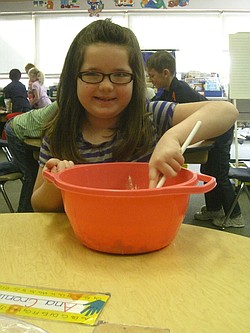
A C.H. Campbell Elementary School first-grader took her turn in stirring the play dough mixture the students made with help from Brenda Markley, Mill Creek MetroParks Farm agricultural facilities manager.
 Photo
Photo
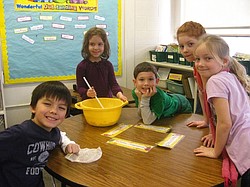
Neighbors | Abby Slanker.A group of C.H. Campbell Elementary School first-graders worked together as a team to mix up a batch of play dough after enjoying a reading of “The Little Red Hen” by Brenda Markley, Mill Creek MetroParks Farm agricultural facilities manager.
 Photo
Photo
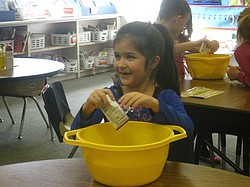
A C.H. Campbell Elementary School first-grader took her turn in adding the Kool-Aid to the mixture of play dough the students made during a visit from Brenda Markley, Mill Creek MetroParks Farm agricultural facilities manager.
By ABBY SLANKER
Brenda Markley, Mill Creek MetroParks Farm agricultural facilities manager, gave all four C.H. Campbell Elementary School first-grade classes a treat when she shared one her favorite farm stories with them when she visited their classrooms Feb. 1. Markley read the students a childhood favorite, “The Little Red Hen.”
In the story, Little Red Hen asks her three friends, the duck, the dog and the cat, to help her plant wheat seeds. When they all say no, she does it herself. When the wheat was grown, Little Red Hen asked her friends to help her cut it. When they said no again, she cuts the wheat herself.
When the wheat was cut, Little Red Hen asked her friends to help her take it to the mill and have it ground into flour. When her friends, once again, said no, she took the wheat to the mill herself. After she brought the sack of flour back to her house, she asked her friends to help her bake bread. Again, they said no, so she baked the bread herself.
When the bread was ready, she asked them who would help her eat the bread. This time, the duck, dog and cat all said they would help. And Little Red Hen, said no and ate the bread herself.
“First-grades are learning to read and are focusing on sequencing in stories. ‘The Little Red Hen’ is a great book to learn about sequencing,” Markley said.
To help the children in Jan Johnson’s class visualize and focus on sequencing, Markley brought with her a felt board to help illustrate the story. She also brought with her items from the farm to show the children, like wheat seeds and gown wheat.
“Today I am bringing the farm to you,” Markley said.
She also offered the children a hands-on opportunity in acting out the parts of the duck, the cat and the dog. When she read about the duck, the children waddled in their seats. When she read about the dog, the children put their ‘paws’ up and bounced in their seats and when she read about the cat, the children curled up with their hands on the side of their faces and pretended to nap.
After finishing the book, Markley applied what happens in the story to what happens on the farm. She explained that at the farm, it is the farmer’s job to plant the wheat seeds and take care of it while it grows. The farmer then receives help from a combine to harvest the wheat. Markley explained this process with the help of a toy combine she brought with her.
After harvesting, she said, the farmer’s job is done as he sells the wheat to the mill. The mill grinds the wheat into flour and people can then bake bread, muffins, cookies, pancakes, spaghetti or tortillas with the flour.
Markley also told the children that the story was first written in the 1800’s and has had many rewrites and authors over time.
“I think the latest story has Little Red Hen making pizza in the end,” Markley said, which brought approval from the students.
As a special treat for the students, and much to the delight of all of them, Markley then announced she brought all the ingredients for them to make dough, but since there was no oven to bake it in, they would make play dough.
The only stipulation was the students had to work as a team, unlike the characters in the story. Each team member was assigned a job. One student added the bag of flour to the bowl. The next student added the water to the flour. The next student added the salt to the mixture and the next student added the oil. The last ingredient was a package of Kool-Aid to provide color and scent. Each student then had a chance to stir the mixture.
“You all must work together to make the play dough,” Markley told the children. “All these jobs need to be combined together to make the end product.”
When the mixing and stirring was done, Markley handed each child their own ball of play dough. The children wasted no time getting creative and making things out of the play dough, like a baseball, a pretzel, a pizza, a heart, a smiley face, worms and a cinnamon roll.
When the children asked Markley if they could take the play dough home with them, she replied, “Well, I certainly don’t need it at my house, so, of course you may take it home.” And with that, a loud cheer went up in the classroom.