 43
43

Students warm up to wool
 Photo
Photo
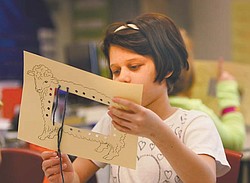
Delilah Lopez, a third-grader at Struthers Elementary School, shows how to make a loom.
By jeanne starmack
struthers
Are you smarter than a Struthers third-grader? That depends on whether you know how wool gets from a sheep to a sweater.
The third-graders at Struthers Elementary School do now. For two days, Monday and Tuesday, each class learned about sheep and the other wool-producing critters — llamas, alpacas and even goats.
They learned how to get wool from a sheep.
“You can shave them,” said Kim Moff, an agricultural educator from Mill Creek MetroParks Farm in Canfield.
In Nancy Birch’s class Monday, the kids watched attentively as Moff held up a tool that looked like a huge, wicked-sharp pair of scissors.
“If I lived on a farm a long time ago, I’d have shears,” she said, adding that sheep are shaved or sheared in the spring.
“We can use the wool, and it keeps them comfortable for summer,” she said.
There’s a system to shearing a sheep — the idea is to get the wool off in one piece — a fleece, she said.
“These people who do this for a living can do it in minutes,” she said.
But the wool is dirty, and it needs to be washed.
“They take raw wool in big bags to a big factory,” Moff said. They wash it in hot water there, and something rises to the top — lanolin, she said.
“How many of you think you use lanolin every day?” she said.
To give them a clue on whether they do or don’t use it, she passed a vial of it around.
They each took a whiff.
“It smells like when an animal gets wet,” said Arianna Dodd.
“Like a dirty sock,” contributed Braydin Schmitt.
“Like a garage!” added Elisha Ricks.
“Like ChapStick,” said Kaylie Bolevich.
“Like a farm,” said Zada Shively.
“Like a cleaning product,” offered Emilee Stranec.
“They clean it and add things — maybe some perfume, and it’s in hand lotion and soap. You’ll find it in conditioner and sometimes in lip gloss and ChapStick,” said Moff. “It soothes your skin.”
So Kaylie was on the nose.
After washing the wool and separating the lanolin, you have a big wet pile of wool. So what’s next?
“You brush it out. That’s what carding is,” Moff said, showing off two large, flat brushes. Once the wool is washed, combed and carded, you have a long piece called roving — and you’re ready to spin the wheel.
No, you’re not playing “Wheel of Fortune.” You’re making yarn, and Moff demonstrated how on an old-fashioned spinning wheel.
Once you have yarn, you are in business.
“I can knit the yarn, or I can weave it or use a hook to crochet,” she said.
Birch’s third-graders tried their hands at weaving. They made looms out of paper and yarn and learned the process: over, under, over, under, with more yarn.
Moff even sparked some thoughts of a possible career in weaving.
“I want to do it more and more times,” said Arianna Dodd. “I want to do it my whole life.”