 43
43

Warren PD now TECH READY
 Photo
Photo
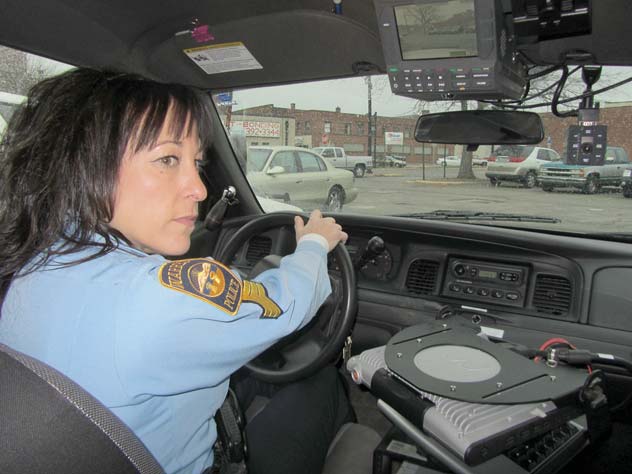
Sgt. Sherrey McMahon of the Warren Police Department sits in one of the patrol cars equipped with video and audio capabilities. The video monitor is at the upper right next to the camera. The department will install the equipment in all patrol cars over the next year to help police better comply with an agreement with the U.S. Justice Department.
By ED RUNYAN
runyan@vindy.com
WARREN
Some people have suggested a major reason that the Warren Police Department came under such scrutiny a decade ago was because it failed to adapt to the important role of video in our lives.
Police Chief Tim Bowers says it’s time for the department to embrace video.
There was a videotape of Lyndal Kimble of Warren being arrested in June 2003. Because it purportedly showed police using excessive force during his arrest, it made news nationally and led to a federal lawsuit against the city.
A few weeks later, a person holding a camcorder shot video of former Police Chief John Mandopoulos and one of his officers at 77 Soul, a Youngstown Road nightclub. The video was described as showing the two acting disrespectfully.
Some have said the Kimble incident was a big factor leading to the 2004 investigation conducted by the U.S. Justice Department’s Civil Rights Division. The investigation resulted in a lengthy set of recommended police-department changes in 2006 and a follow-up settlement three weeks ago.
Putting video cameras in every patrol car is among the steps Bowers and other police administrators will hope to accomplish as the department tries to comply with the Justice Department settlement agreement.
Currently, about one-fourth of the patrol cars are video-equipped.
“I think a camera in the car reassures the officer and the citizen that the truth of the matter will be determined,” Bowers said.
“Everyone’s got a camera in their pocket,” Bowers said. “I want to be able to say that whenever someone has contact with a Warren policeman, it’s on video. You don’t have to take your own video, I’ve already got it,” Bowers said.
Bowers noted that in 2011, the department received 44 citizen complaints out of more than 40,000 calls for service.
“... That’s not bad considering we are the only ones who can come into your home and say, ‘Stop beating your wife,’” Bowers said.
One reason why video increasingly will be important for the department is that the consent agreement defines the standard the top department administration must use to determine whether officers used excessive force.
The new standard weighs more heavily in favor of the public than in the past.
Another big change mandated by the settlement is that the city institute an early-intervention and risk-management system in which problems and problem officers are identified early.
Bowers said the department already has most of the information required to institute this type of system. What it needs to make it work best is computer software that tracks the information and produces reports showing trends.
It keeps track, for instance, of the number of times an officer is involved in an incident involving a citizen resisting arrest or obstructing official business. It tracks the number of citizen complaints filed against the officer, the number of times the officer calls off and arrives late, the number of times the officer uses a firearm or stun gun.
The agreement requires the police department to produce a report each year on each officer and that the police department’s top administrators analyze each report.
The department is expecting to use $8,000 from a federal grant to pay for the software.
Furthermore, the agreement calls for the department to create a matrix that spells out the type of disciplinary action that will be given for specific types of infractions.
The department has revised its use-of-force policy several times in response to interaction with the Justice Department since 2004, Bowers said. The department also made significant changes to its citizen-complaint process.
The Justice Department came back in the summer of 2010, however, and asked for additional changes.
“It’s taking us, especially in the use-of-force policy, where we thought we had 100 percent compliance, and tweaking it up,” Bowers said. “We’ll comply. We’ll do it.”
Among the most-important concepts is to train officers that in situations that could lead to high levels of force being used against citizens, to consider options other than immediate action, such as waiting for additional officers or waiting for a crisis-response team.
Training in the new use-of-force policy is expected to begin this month with most of the training coming from supervisors and officers within the department, such as Sgt. Jeff Cole, Capt. Joe Marhulik, Lt. Eric Merkel and Detective Mike Currington.
Steven Dettelbach, U.S. attorney for the Northern District of Ohio, said there is cost and work associated with implementing the changes, but Bowers is not “afraid to change,” and the agreement gives the department the time to make them.
Jonathan Smith, chief of the special-litigation section of the Justice Department’s Civil Rights Division, said Warren is among the smallest of the 20 police departments the department is working with right now.
The Justice Department is working with a large number of police agencies to “give meaning to the civil-rights laws,” Smith said.
Mayor Doug Franklin says the agreement is a “win for the city of Warren” and a “turning of the corner for the Warren Police Department.”
Hilary Taylor, an attorney who has assisted the Warren Law Department in negotiations with the Justice Department, said having a mutually acceptable agreement is much better than the “rancor of lawsuits.”