 43
43

New stat shows average car is more than 10 years old
 Photo
Photo
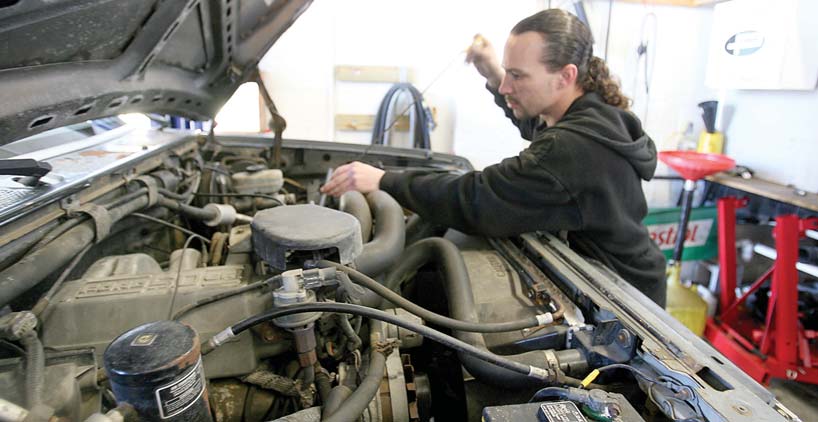
Mike Corps checks fluid levels after servicing a truck at Boardman Auto on Indianola Road. Corps said he has been swamped with customers since he opened at the beginning of the year, many of whom are trying to maintain their vehicles for as long as possible.
RELATED: Officials pleased with Cruze figures
By Karl Henkel
khenkel@vindy.com
BOARDMAN
Mike Corps’ township auto-repair shop has been open only a month, but he’s already flush with business, tending to two to three vehicle repairs each day.
“I’ve been slammed,” said the 15-year auto-repair vet, a one-man band at 119 Indianola Road. “I can’t keep up.”
Corps’ experience tells him he didn’t just get lucky, grabbing more business than he can handle in just 31 days.
Drivers are wising up.
Their cars — now older than ever before — have become blessings instead of burdens, especially financially.
“People now don’t seem to have a problem spending a few hundred dollars to keep it [the vehicle] on the road, especially if it’s going to last a few more years,” he said.
Those vehicles, with monotonous maintenance, are lasting much
longer.
The average age of cars and light trucks is now 10.8 years, according to Southfield, Mich.-based R.L. Polk Co., an automotive market intelligence firm.
Passenger cars are now, on average, 11.1 years old, up from 11 years in 2010.
The average age of passenger cars and light trucks has now increased 2.4 years, or 28 percent, since 1995 and has increased every year since 2001.
Part of the reason for the recent age jump was the 2009 Car Allowance Rebate System — better known as Cash For Clunkers — a $3 billion federal policy that offered new-car rebates in exchange for old, fuel-inefficient vehicles.
The program took nearly 700,000 older vehicles off the road, essentially wiping out that segment of the used-car population and increasing used-car demand.
“It contributed somewhat but it wasn’t the only reason,” said Jesse Toprak, auto analyst at TrueCar.com. “Cars are being built with much more longevity.”
And because of the augmented longevity, Toprak said used cars, if kept in tip-top shape, can cost nearly as much as a new car.
With a struggling economy and demand for few well-conditioned used cars, drivers are forced to stick with their current set of wheels, hence increasing ages of cars.
According to an Aftermarket Insider 2011 report, longer-lasting vehicles are extending the vehicle-repair window, and consumers are opting to maintain vehicles instead of buying new ones.
That boon doesn’t appear to be slowing down anytime soon.
IHS Global Insight projects that the automotive aftermarket sales will increase to $248 billion by 2014, up from $178 billion in 2002.
But how much longer can that last?
R.L. Polk attributes increased age of cars to a decrease in vehicle sales during the recession and expects the trend to reverse when car sales reach equilibrium — 14.5 million annually, Toprak said, a figure automakers likely won’t hit for another year.
Here in the Mahoning Valley, keeping old cars didn’t hamper new-car sales.
Local dealers sold 24,651 new cars in 2011, a 25-percent increase compared with 2010 and the most since dealers sold 27,362 in 2007.
Steve Chos, executive vice president of the Auto Dealers Association of Eastern Ohio, said after a nationwide down year in sales like 2009 because of the federal auto loans to Chrysler and General Motors coupled with the trough of the recession, it was just a matter of time before the economic climate started to improve and Americans returned to buying new cars.
“Was a portion of that due to the aging of the cars out there?” Chos said. “I think it certainly is.”