 43
43

Officials explain $341,000 price tag for facility
 Photo
Photo
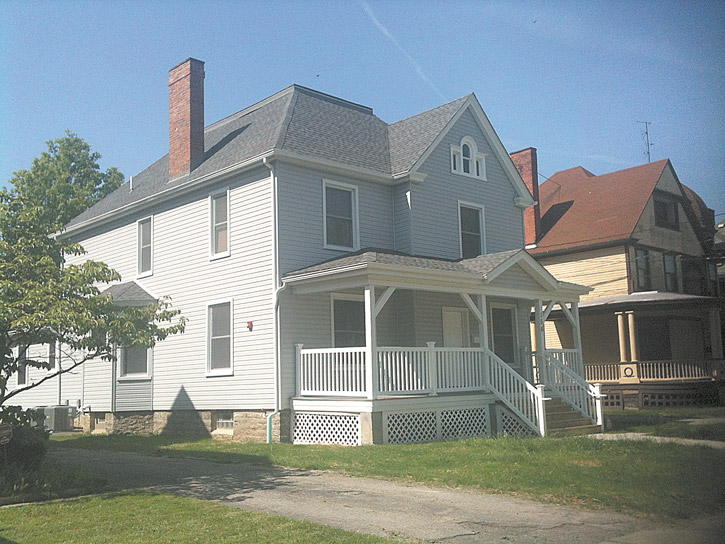
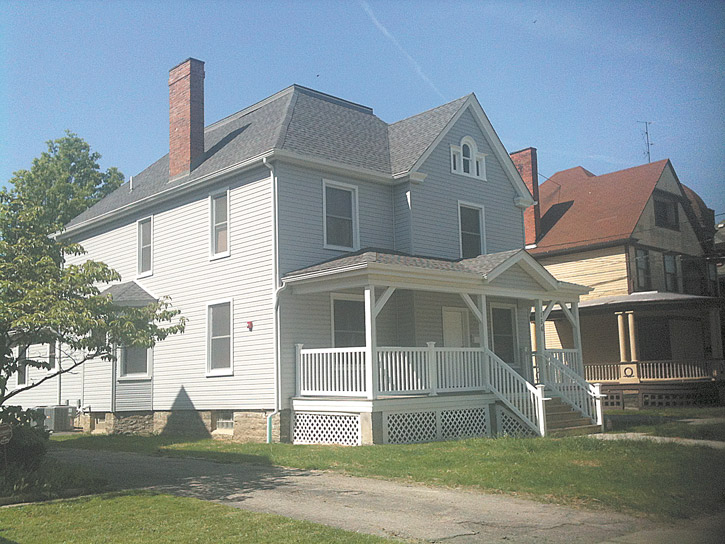
A transitional housing facility run by Coleman Behavioral Services in Warren was recently honored by the Ohio Department of Development for its innovation and community development.
By Ed Runyan
WARREN
So why did it cost $341,000 to renovate a century home on Washington Street Northeast to provide a place where up to eight young adults could live while learning how to avoid homelessness?
Wouldn’t $341,000 be enough money to build an enormous mansion somewhere outside of the city?
Tammy Weaver of Coleman Behavioral Services says the first thing to know is that this renovation required removing everything in the house “down to the studs” and installation of items that wouldn’t be needed in most new construction, such as an alarm system.
Julie Green, grants coordinator for the Trumbull County Planning Commission, who handled grant administration, added that the renovation required $15,000 worth of electrical work, $20,000 in plumbing, $30,000 of heating and cooling and $41,000 of lead-paint removal.
Carpentry to add 955 square feet of additional living space on the first floor, renovations throughout, and turning an 800-square foot attic into a meeting and recreation area cost $208,000.
Green says the project was paid for with $413,000 from the county’s $3.4 million share of Neighborhood Stabilization Program funds, authorized by Congress in July 2008 while George W. Bush was president.
In addition to the renovation costs, there were $25,000 to buy the property and $42,470 for engineering/architectural work.
A primary goal of NSP, approved when the national housing foreclosure crisis was at its peak, was to address the foreclosure problem, Green said, so a requirement of the program was to spend the money on a foreclosed property.
As for whether it would have been cheaper to build a new structure or renovate the old one, Green said she doesn’t know.
Mike Sliwinski, the county’s chief building official, said the cost to renovate old and to build new generally is about the same.
Meanwhile, the standard cost Sliwinski uses for new construction in Trumbull County is about $105 per square foot for a group home or about $80 for residential.
The Washington Street facility has 3,233 square feet of living space, 4,033 if you count the 800 square feet in the attic.
That works out to $322,640 for residential new construction or $423,465 for new group-home construction.
Green noted that four companies offered bids on the project. The county awarded it to the low bidder, Riley Construction LLC of Warren. Other bids were as high as $503,000.
A contractor who has built new homes in the $300,000 range over the years, Gil Starr, owner of Starr Construction of Girard, said he believes most government construction and renovation projects cost more than private construction.
In May, when he read about the $10 million renovation of the Youngstown Metropolitan Housing Authority’s Brier Hill Annex, he was a bit peeved about the cost. That renovation provided 76 apartments, meaning the cost was $131,579 per apartment.
“I said do you realize they could have built each person a new house for $131,000 apiece?” Starr said.
When you start talking about removing asbestos and lead-based paint, Starr said, he understands why the cost of the Washington Street renovation was high, but he still finds it “ridiculous” that the cost was $341,000.
Weaver, whose company has 188 housing units for people in danger of being homeless, said she thinks the $341,000 is in line with what similar projects have cost.
“No I don’t think it’s high when you look at the investment in the community — taking a house that was not livable, trying to reclaim the neighborhood and taking eight people off the streets,” Weaver said.