 43
43

Skittles joins other food brands at center of tragedy
 Photo
Photo
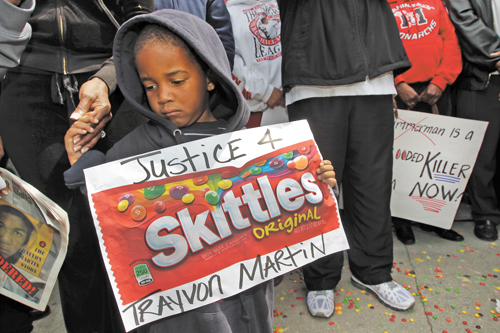
Steven Jonhson, 3, holds an enlarged banner of Skittles candy as he joins Los Angeles community members at a “Justice for Trayvon Martin hoodie rally” to protest the death of Trayvon Martin, an unarmed black teenager who was shot and killed by neighborhood watch captain George Zimmerman.
Associated Press
NEW YORK
It could’ve been Starbursts, Twizzlers or Sour Patch Kids. But when Trayvon Martin was fatally shot, he happened to be carrying a bag of Skittles.
The 17-year-old’s death at the hands of a neighborhood watchman in February ignited nationwide protests and heated debate about racial profiling and “Stand Your Ground” laws.
For Mars Inc., the privately held company that owns Skittles, the tragedy presents another, more surreal dimension. Protestors carried bags of the chewy fruit-flavored candy while marching for the arrest of shooter George Zimmerman. Mourners pinned the bright red wrappers to their hooded sweat shirts at memorial services.
On eBay, vendors sell $10 T-shirts with the words “Justice for Trayvon Martin” printed over a cartoonlike rainbow of pouring Skittles.
Wm. Wrigley Jr. Company —the unit of Mars that owns Skittles— issued only a brief statement offering condolences to Martin’s friends and family, adding that it would be inappropriate to comment further “as we would never wish for our actions to be perceived as an attempt of commercial gain.”
Skittles isn’t the first popular food brand to find itself at the center of a major controversy. The terms “the Twinkie defense” and “don’t drink the Kool-Aid” became part of the vernacular decades ago in the wake of tragic events. More recently, Doritos made headlines when it was reported that the corn chips were Saddam Hussein’s favorite snack.
The cases show how millions of advertising and marketing dollars can be rendered powerless when a company’s product is swept into a big news story. Hostess Brands Inc., which owns Twinkies, says it does not have any archival information on how it handled the popularization of the term “the Twinkie defense.” The phrase was used derisively by the media during the trial of Dan White, who fatally shot San Francisco Mayor George Moscone and city supervisor Harvey Milk in 1978. White’s lawyers cited his poor eating habits as a sign of his depressed state.
As for “don’t drink the Kool-Aid,” younger generations may not realize the phrase has its origins in the 1978 mass suicide in Jonestown, Guyana, where Reverend Jim Jones led more than 900 members of the Peoples Temple to drink a grape-flavored drink laced with cyanide.
The powdered mix used to make the concoction was actually the lesser-known Flavor Aid. Even so, executives at Kraft Foods Inc., which owns Kool-Aid, decided to let the matter go rather than set the record straight.
“It would be like spitting into the wind at this point — it’s just part of the national lexicon,” said Bridget MacConnell, a Kraft spokeswoman. “We all try to protect the value of our brands. But this one just kind of got away from us. I don’t think there was any way to fight it.”
MacConnell added that Kool-Aid remains a popular drink and that the Jonestown tragedy has not overshadowed the brand.
As difficult as it may be for companies to weather controversy, the uncomfortable attention doesn’t spell the end of a product. Hostess and Kraft say they don’t have information on whether the “Twinkie” and “Kool-Aid” catch-phrases had an impact on sales. But both brands clearly survived.
Wm. Wrigley Jr. Company declined to say whether the Martin case has had an impact on Skittles sales.