 43
43

Stations of the Cross mark Good Friday, ills of modern world
 Photo
Photo
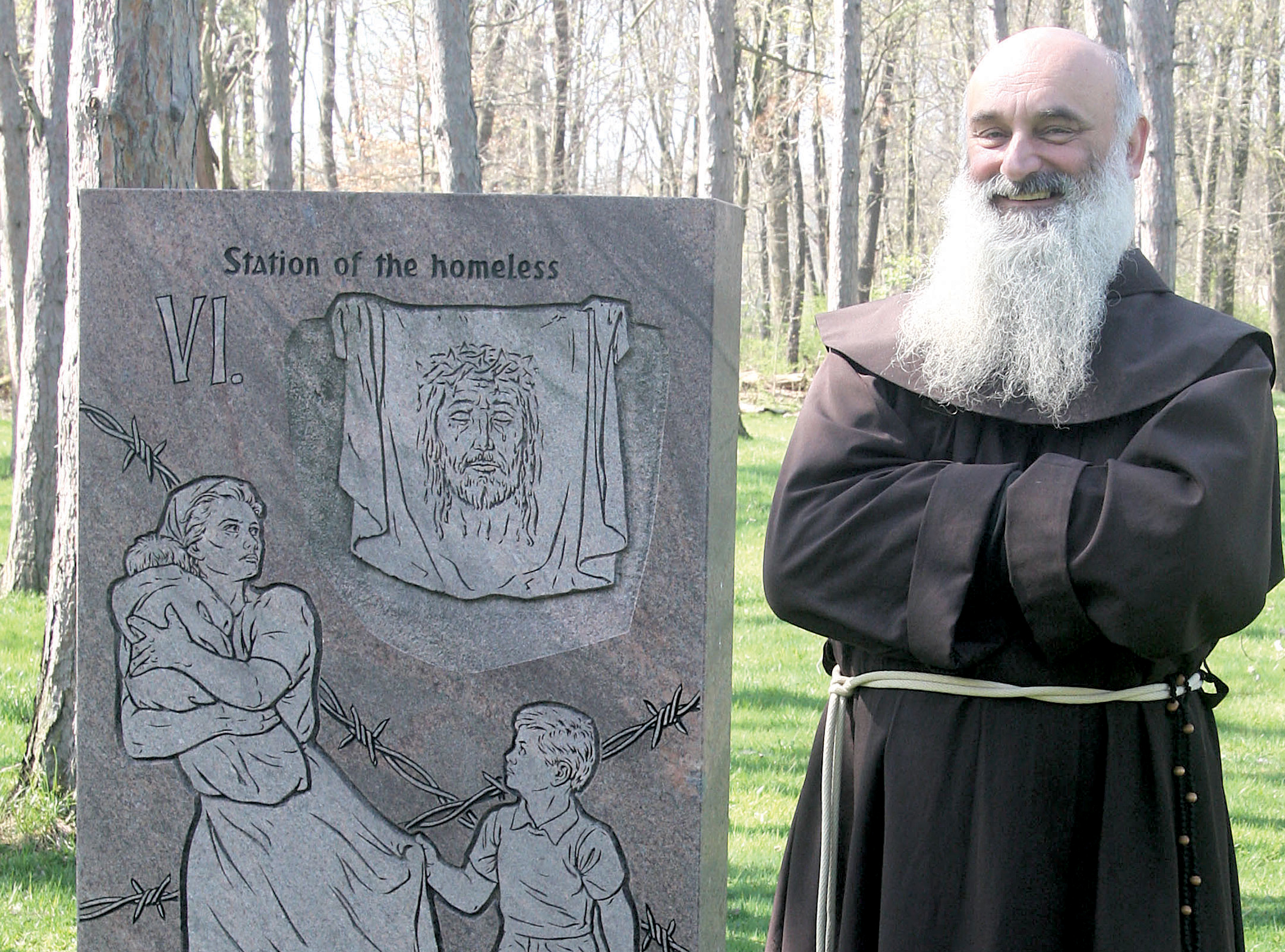
The Rev. Vit Fiala, a Franciscan friar at Shrine of Our Lady, Comforter of the Afflicted, stands beside an Iron Curtain Station of the Cross on shrine grounds. The sixth station is Veronica wiping the face of Jesus, exemplified by a face on cloth; the Iron Curtain version depicts homelessness.
By LINDA M. LINONIS
youngstown
A 32-acre oasis on the West Side named Meditation Park personifies beauty and peacefulness.
It’s a site where not one, but two, historic statues are displayed.
And it’s host to a unique devotion, the Iron Curtain Stations of the Cross.
The Shrine of Our Lady, Comforter of the Afflicted, 517 S. Belle Vista Ave., is staffed by two Franciscan friars. The Revs. Vit Fiala and Jules Wong belong to the Order of Friars Minor in the Province of Immaculate Conception of New York, N.Y.
Father Vit gave a tour of the grounds and an explanation of the Iron Curtain stations. Stations of the Cross depict scenes from the Passion of Christ, which is remembered today, Good Friday. Stations are artistic representations, usually in sculpture or paintings, of Christ’s journey with the cross.
The Iron Curtain Stations of the Cross have broader appeal because they show human conditions under Communist oppression. These stations reflect scenes from the Passion but also depict human situations such as prison, bondage, forced labor, barricaded churches, homelessness, suffering, anguish, death by hanging, despair, oppression and death in war. Father Vit said those conditions remain part of the world today.
“The Church is the body of Christ,” said Father Vit, referring to the connection between believers and Jesus. Jesus’ suffering is chronicled in the stations and the Iron Curtain set details human distress.
Each station is accompanied by a cross in red pine; the station itself is of marble, a design etched into it. Stations vary in size and are rectangular or square. The outdoor stations are positioned in the grass along a one-third -mile long paved path, making a loop and ending near the beginning. English and Hungarian wording is on the statues.
Nearby is the Cathedral in the Pines, where open-air Masses take place. “There are some people who come daily, regularly, to meditate and reflect,” Father Vit said. “It’s a place where you can achieve inner peace or a glimpse of peace.”
Hungarian Catholics have a strong tie to the shrine’s stations. Soviets drove Franciscans out of the Marian sanctuary in Csiksomly in the Transylvania region of Rumania in 1948. In 1963, the friars received permission to build a new monastery and replica of the country shrine in Youngstown.
Recently, members of Holy Apostle Parish (merger of Sts. Peter and Paul Croatian Catholic Church, Our Lady of Hungary and St. Stephen of Hungary churches) held an outdoor Mass and walked the stations. “We wanted to re-establish a tradition,” said the Rev. Joseph Rudjak, pastor. “We found the stations to be very meaningful,” he said, adding “they solidified us, and we bonded.”
Father Rudjak said the Iron Curtain stations motivate those who walk them to think about “the suffering of people” and how the talents of many went undeveloped because of oppression. The stations heighten awareness of injustices, Father Rudjak said.
The shrine is home to one of four marble statues from Fatima, Portugal, where three shepherd children saw a repeated apparition of the Blessed Mother in 1917. A cedar Blessed Mother statue in the shrine also is significant. “This statue was carried in processions in Fatima,” Father Vit said.
Another historic statue on the grounds is St. Stephen of Hungary, the first canonized monarch. The statue of metal that looks like stone was displayed at the 1938 World Exhibition in New York. The statue never returned to its homeland because of World War II. A Cleveland millionaire bought it then donated it the Franciscans when he learned about their shrine.
The shrine has no membership; people who come to the shrine belong to parishes.