 43
43

Valley’s Miracle Baby
 Photo
Photo
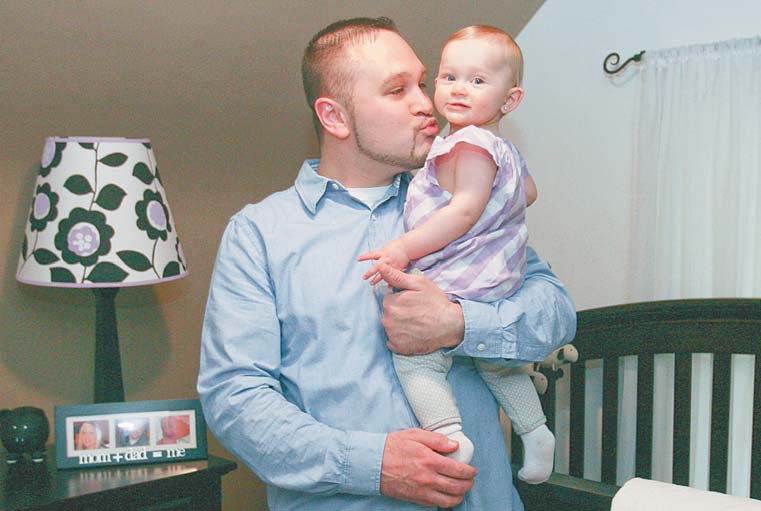
Kenley Schiraldi, who will be 1 year old this month, is a miracle baby conceived with the help of a new technique for sperm preservation. Cuddling her is dad Jason. The family, including mom Jennifer, lives in Campbell.
CAMPBELL
Little Kenley Schiraldi doesn’t know it yet, but her conception was pretty much a modern day miracle.
It took a novel technique in sperm preservation at the Cleveland Clinic and perhaps more than a little luck to bring her into the world.
Kenley is a true miracle, say her parents, Jason and Jennifer Schiraldi of Campbell.
Happy and healthy, Kenley is about to let go of the furniture and walk on her own. She will celebrate her first birthday April 20.
Everything is normal and wonderful, her parents said.
Kenley and the family’s Boston terrier, Piper, have bonded. “Every where you see Kenley, you see Piper,” Jennifer said with a smile.
“She sleeps through the night. She’s a real easy baby,” said Jason.
But her conception was anything but certain and easy.
That’s where the miracle, or maybe miracles, came into play.
Kenley is the product of the only live sperm successfully isolated and frozen after Jason underwent a testicular biopsy.
She was the first child to be conceived with the new technique that enables the freezing and retrieval of a single sperm.
Usually hundreds of sperm are harvested from a semen sample of millions and frozen in preparation for in vitro fertilization. Jason had testicular failure, and only four live sperm were observed. One sperm was frozen using the new freezing technique, said Dr. Nina Desai, director of the Cleveland Clinic IVF Laboratory, who with her team developed the technique.
Kenley is also believed to be the first child conceived in the world using a single frozen sperm.
Jason said he has had no health issues and is aware of no trauma that would cause testicular failure. Doctors haven’t found a reason, he said.
At the time of IVF, the singly frozen sperm ended up as the only living sperm, which meant only one chance for conception, and that was not a certainty.
The Schiraldis had wanted to get pregnant for a couple of years, but when it didn’t happen they went to a specialist and then turned to IVF. Jason underwent the biopsy, and the live sperm retrieved were immediately frozen.
The problem is that not all sperm live through the freezing process, said Dr. Desai.
“This case was very special because we were trying to freeze one sperm about the size of the tip of a sewing needle. Usually we have more living sperm, and if some are lost in the retrieval process there are others left alive,” she said.
The trick is getting a single sperm alive out of the container in which it is frozen because the sperm tend to attach themselves to the sides of the vessel and die; and also to make sure they don’t die during the process.
With only one chance for the Schiraldis, Dr. Desai and her team developed a new technique for loading and unloading the sperm from the vessel to get it back alive.
“All I did was figure out how to get it back ... to get it off the vessel without losing it,” she said.
It was as simple, and as daunting, as freezing the sperm at the right rate.
“We tried several methods and finally developed a technique that worked that other labs can apply fairly easily,” Dr. Desai said, when asked about the larger significance of her discovery.
“I don’t know why it wasn’t thought of sooner,” said Dr. Desai. “We just figured out how to slow down the freezing process and a technique for unloading the sperm without it being damaged or lost,” she said.
The new technique was published in the March edition of the Journal of Assisted Reproduction and Genetics.
But having just one live sperm was not the only challenge to conception.
“The egg was chosen at random, and not every fertilized embryo results in pregnancy,” Dr. Desai said.
There was no second chance, but in the Schiraldi’s case, it was all that was needed.
SDLqWe were very happy when Jennifer became pregnant and delivered a baby,” she said.
Pure, undiluted joy is what Jason and Jennifer felt at Kenley’s birth.
They knew pregnancy was not a certainty. They knew there was one chance for conception. They had decided if IVF did not work, they would adopt a child.
They prayed.
Kenley was the heretofore nearly impossible result.
“The Cleveland Clinic asked us to share our story and we said yes to let other people like us know there is another option ... that now there is a way,” said Jason.
Jennifer’s pregnancy was normal and not considered high-risk. However, Kenley was born at Northside Medical Center via a Cesarean section (C section), a surgical delivery, because she was breeched.
Most babies move into delivery position a few weeks prior to birth with the head moving closer to the birth canal. When this fails to happen, the baby’s buttocks and/or feet are positioned to be delivered first, referred to as a breech.
“I’ve said this from the get-go. I don’t know any other way to describe it. It’s a miracle,” Jason said.
“Kenley is very special to us no matter how she got here. I look at her every day and feel this unbelievable love. People say the love you feel is indescribable, and they are right,” Jennifer said softly.
Kenley goes to day care and a sitter when Jennifer, 33, and Jason, 35, are working.
She is a nutrition services supervisor at Northside, and he is a nurse in the cardiovascular lab at St Elizabeth Health Center.
Jennifer, daughter of Karen and Joe Speziale of Lowellville, graduated from Lowellville High School in 1996, and Jason, son of Linda Beight of Poland, and the late Gary Schiraldi, graduated from Lowellville High School in 1994. She has a bachelor of applied science degree in nutrition and he has a bachelor of science in nursing degree, both from Youngstown State University.