 43
43

Dead Sea Scrolls go online
ASSOCIATED PRESS
 Photo
Photo
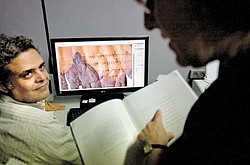
Photographer Yair Medina, left, shows Pnina Shor, right, curator and Head of Dead Sea Scrolls Project at the Israel Antiquities Authority, IAA, scanned fragments of the Dead Sea Scrolls on a computer screen, at the IAA offices at the Israel Museum in Jerusalem, Monday, Sept. 26, 2011. Two thousand years after they were written and decades after they were found in desert caves, some of the world-famous Dead Sea Scrolls are available online. Israel's national museum and the international web giant Google are behind the project, which saw five scrolls go online Monday. (AP Photo/Sebastian Scheiner)
Associated Press
JERUSALEM
Two thousand years after they were written and decades after they were found in desert caves, some of the world-famous Dead Sea Scrolls went online for the first time Monday in a project launched by Israel’s national museum and the Web giant Google.
The appearance of five of the most-important Dead Sea scrolls on the Internet is part of a broader attempt by the custodians of the celebrated manuscripts — who once were criticized for allowing them to be monopolized by small circles of scholars — to make them available to anyone with a computer.
The scrolls include the biblical Book of Isaiah, the manuscript known as the Temple Scroll, and three others. Surfers can search high-resolution images of the scrolls for specific passages, zoom in and out, and translate verses into English.
The originals are kept in a secured vault in a Jerusalem building constructed specifically to house the scrolls. Access requires at least three separate keys, a magnetic card and a secret code.
The five scrolls are among those purchased by Israeli researchers between 1947 and 1967 from antiquities dealers, having first been found by Bedouin shepherds in the Judean Desert.
The scrolls, considered by many to be the most- significant archaeological find of the 20th century, are thought to have been written or collected by an ascetic Jewish sect that fled Jerusalem for the desert 2,000 years ago and settled at Qumran on the banks of the Dead Sea. The hundreds of manuscripts that survived, partially or in full, in caves near the site, have shed light on the development of the Hebrew Bible and the origins of Christianity.
The most complete scrolls are held by the Israel Museum, with more pieces and smaller fragments found in other institutions and private collections.