 43
43

Replacements are the bee’s knees
 Photo
Photo
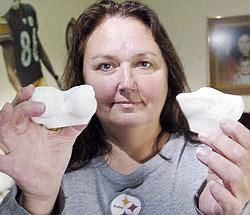
Maureen LaLama, 54, of Boardman had a double-knee replacement. Her right knee had been damaged from years of arthritis. Today, she is back working light duty at ValleyCare Northside Medical Center.
BOARDMAN
It was March 15, and Maureen LaLama was checking one last thing before heading out the door to attend a funeral.
“I was going down to the basement, and the fourth step from the bottom, my left knee just collapsed. My left knee was always my good knee,” said the 54-year-old mother from Boardman.
LaLama could barely walk, let alone swing dance, one of her favorite weekly activities.
“If you saw me walking down the hall, you would either laugh or cry,” she said. “When you can’t walk, you can’t do anything.”
In July, LaLama had a double knee replacement. Her right knee had been damaged from years of arthritis. Today, she is back working light-duty at ValleyCare Northside Medical Center.
What made the difference, said Dr. James Kerrigan, is the technology used in the surgery.
For the past three years, Dr. Kerrigan and the staff at Youngstown Orthopaedic Associates have used MRI 3D scans in 120 cases to create replicas of patients’ bad knees.
“What the MRI does is, it allows us to make a copy or a model, and [a computer] predicts to the surgeon where the cuts should be made to best fit the prosthesis,” said Dr. Kerrigan, who performed LaLama’s surgery.
Scans are taken of the ankles, knees and hips, and then, 3D imaging is used on the knee, said Beth White, director of specialty imaging at Youngstown Orthopaedic Associates.
“These different measurements are used to make a cutting block,” which surgeons use to trim the bone, White said.
More and more people are taking advantage of this technique for knee replacements, Dr. Kerrigan said.
The benefits are “smaller cuts, it’s less invasive, there’s less bleeding, it’s less time and leads to faster rehabilitation,” Dr. Kerrigan said. Instead of a knee replacement taking 90 minutes, it’s down to 60, he added.
“The biggest advantage is the alignment; it customizes the alignment,” he said, stressing that it’s not a customized knee prosthesis.
Dr. Kerrigan said LaLama had “horrible knees” and was “tremendously bowlegged,” and as a result, she felt better almost immediately after the surgery.
But each patient’s experience is different, he said.
The knees should last between 25 and 30 years, LaLama said.
After an intense, 10-day stint at Hillside Rehabiltion Center — “I grunted like Serena Williams during therapy” — LaLama continues her daily exercises and walks and still attends hourlong supervised therapy sessions twice a week.
She’s hoping to be back to 100 percent next month, when she’ll resume regular work hours.
“It is such a joy to walk,” she said.
And soon, she’ll be back to swing dancing every Tuesday.