 43
43

Poland youth get a lesson in pioneer days
 Photo
Photo
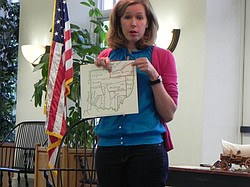
Neighbors | Sarah Foor .Mahoning Valley Historical Society curator of education Rebecca Whittenberger discussed the daily lives of early pioneers in a discussion at the Poland library on July 25. For reference, Whittenberger pointed out that her talk focused on the area of Ohio called the Connecticut Western Reserve, which she is pointing to on her map.
 Photo
Photo
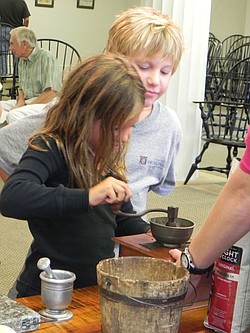
Neighbors | Sarah Foor .Eva Johnson (left) tried her strength as she swung the arm of an old-fashioned coffee grinder, while her brother, Miles Johnson, looked on.
 Photo
Photo
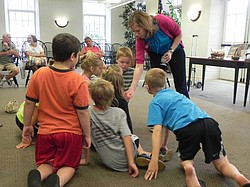
Neighbors | Sarah Foor .Host Rebecca Whittenberger (right) explained the use of a mortar and pestle for medicinal uses during pioneer times. A simple headache cure were crushed cloves, which Whittenberger showed to the group whole before crushing them in the tool.
By SARAH FOOR
Although the summer reading program has spent months traveling the world with its “One World, Many Stories” theme, the Poland library also wanted to explore some of the stories in our own backyard.
Packed with the suitcase full of pioneer artifacts, the Mahoning Valley Historical Society visited the Poland facility on July 26 to entertain an audience of all ages with tales of Northeast Ohio history.
Historical society curator of education Rebecca Whittenberger allowed the pioneer artifacts be the star of the show and offered a hands-on, sensory and interactive discussion.
“We’re offering an artifact observation experience. I want them to touch and observe our artifacts so that they understand what they are and how important they were in everyday pioneer life,” Whittenberger said.
Whittenberger primarily focused on the pioneers who traveled to Ohio after the creation of the Connecticut Western Reserve in 1796. “A Journey to Ohio in 1810” by Margaret Van Horn Dwight was used a reference to guess what a pioneer might encounter on their journey to and settlement in Ohio.
Whittenberger explained the difficult process of building a log cabin, which many locals used as necessary protection. “If you can imagine it, our area used to be overrun by wolves. In the early 1800s, there were no sheep here for 15 years because the wolves continued to wipe them out. A lot has changed, right?” Whittenberger said.
The educator then explored tools like a candle mold, clothes iron, coffee grinder, mortar and pestle, and soap stone that warmed cold pioneer feet in the Ohio winters.
Whittenberger introduced simple, but still entertaining, toys like ball-and-cup, Jacob’s ladder and buzzsaw, and guests were free to try them out.
While testing out the ball-and-cup game, guest Eva Johnson was offered a simple question – could she be a pioneer child?
Johnson went for complete honesty.
“I don’t think so. It looks really hard!”