 43
43

Fourth-graders bloom during study
 Photo
Photo
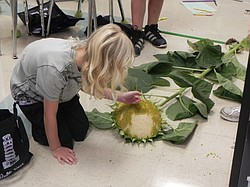
Neighbors | Sarah Foor .Student Jaki Prusak (left) got up close and personal with her sunflower to count the petals for her group report.
 Photo
Photo
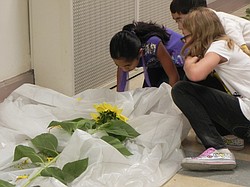
Neighbors | Sarah Foor .Team members Charisma Ojeda (left), Antonio Gay, and Serena Studzinski bent down to get a closer look at their sunflower on Sept. 22.
 Photo
Photo
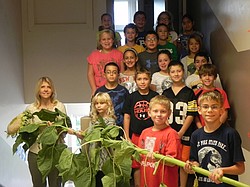
Neighbors | Sarah Foor .After a morning of sunflower fun, the students of of Michelle Landers' fourth-grade classroom showed off their smiles and one of the giant sunflowers they studied during their class project.
By SARAH FOOR
Although many measure the transition from summer to fall by the start of their school year, the true first day of autumn began Sept. 23. To celebrate and observe the last vestiges of summertime, the students Michelle Landers’ fourth-grade Union classroom studied the quintessential summer bloom, the sunflower, on Sept. 22.
Landers’ sunflower study began when Laura Scotford, mother of a former student, offered Landers her sunflower blooms when summer waned.
“It’s a very unique opportunity for the kids, because we’re able to split up into very small groups and observe the sunflowers up close. Today’s lesson is obviously about science and biology, but I also have the students integrating math, writing, and reading skills, as well as discovering tools for inquiry,” said Landers.
On the morning of Sept. 22, Scotford delivered seven giant sunflowers to Landers’ classroom. The fourth-grade students participated in hands-on group work as they measured the sunflower stalk, counted leaves, petals, and seeds, and compared the sunny blooms to other flowers in a Venn diagram.
When asked to measure the flower stem, fourth-grader Nate Garthwaite told his group, “It’s probably taller than us. I think it’s taller than Miss Landers, too. They’re the biggest flowers I’ve ever seen.”
After the day of observation, the flowers didn’t go to waste.
“We’ll send the flowers to our outdoor classroom later today, where local animals can eat their seeds. The plants will decompose naturally and add to our Union ecosystem,” said Landers.