 43
43

Decontamination unit ready for use
 Photo
Photo
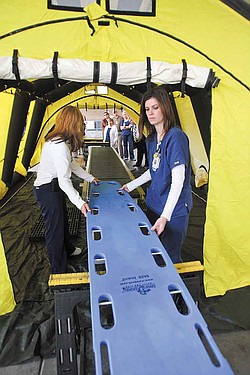
Humility of Mary Health Partners conducted orientation sessions about a decontamination unit for senior leadership in St. Elizabeth Health Centers in Youngstown and Boardman and at St. Joseph Health Center in Warren on Monday. Here St. Elizabeth registered nurses, Brenda Luchs, left, and Amanda Lencyk, demonstrate how nonambulatory patients are moved through a decontamination tent.
YOUNGSTOWN
When an event requiring decontamination of people exposed to hazardous materials occurs, a local decontamination unit is ready to go.
It was formed a decade ago after an anthrax scare as a joint venture of St. Elizabeth Health Center and the Mahoning County Emergency Management Agency.
The unit is also used for training medical personnel, which was the purpose of its visits Monday outside the emergency departments of St. Elizabeth Health Center on Belmont Avenue and in Boardman and at St. Joseph Health Center in Warren; the visits were to provide orientation sessions for senior leadership at the hospitals.
The senior leaders are in command centers during emergencies and may not be familiar with the decontamination units in the field. Emergency department personnel receive annual training, said John Hughes, manager of St. Elizabeth Health Center’s critical-care outreach program.
The decontamination unit has been used in only one real situation, but it responds to every call-out of the Mahoning County Emergency Management HAZMAT (hazardous materials) Response Team in case it is needed, Hughes said.
He said the unit was used several years ago to decontaminate about 30 Youngstown firefighters who were exposed to petroleum products while fighting a fire on Wilson Avenue.
The decontamination unit consists of a trailer with equipment including two inflatable decontamination tents, one for ambulatory patients and one for patients on stretchers, and medical personnel protective gear with breathing apparatus. A retired St. Elizabeth ambulance was converted to tow the trailer and carry additional equipment.
Patients who go through the ambulatory and non-ambulatory decontamination tents are cleaned with simple dish-washing soap and warm-water showers. Hughes said the warm water is a nice feature that makes the process a lot more comfortable.
Hughes, who conducted the orientation session, said the decontamination trailer and its original equipment was purchased with a $76,000 Federal Emergency Management Agency grant shortly after the 2001 anthrax scare.
At that time, letters laced with the substance killed five people and disrupted post offices.
The scare of anthrax at the post office was what prompted getting the decontamination unit, said Hughes, retired Poland assistant fire chief and a former paramedic with Gold Cross Ambulance Services.
He said events that might trigger use of the decontamination unit include crashes with spills and industrial accidents.
Common items such as fertilizer and chlorine, which can cause burns and respiratory problems, could require someone to go through the decontamination unit, he said.