 43
43

‘Sunkink’ blamed for derailment
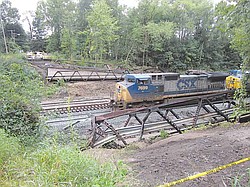
 Photo
Photo
The CSX train derailment at the Fifth Street crossing on the south end of Niles on July 30 resulted in $734,000 worth of damage to train equipment, track, signals and structures. Among the damage was destruction of the Fifth Street bridge, which carried vehicle traffic over the rail line between the Fifth Street neighborhood and Salt Springs Road.
By Ed Runyan
NILES
The CSX train derailment at the Fifth Street crossing on the south end of town July 30 was caused by what rail officials call “sunkink,” an expanding and bending of rail tracks as a result of heat.
The 2:30 p.m. derailment, which did not require any evacuation or cause any injuries, resulted in $734,000 in damage to train equipment, track, signals and structures, CSX reported to the Federal Railroad Administration.
Among the damage was destruction of the Fifth Street bridge, which carried vehicle traffic over the rail line between the Fifth Street neighborhood and Salt Springs Road. The bridge, owned by CSX, has been closed since the accident.
Before the derailment, the bridge was heavily used by motorists traveling between Niles and Lordstown, residents said.
The bridge, about 150 feet long with wooden planks, was believed to be about 100 years old.
CSX will replace the bridge this winter and expects it to be ready by spring, said Mark Hess, Niles grant and development coordinator.
Hess said he doesn’t know the cost of the new bridge, but the city of Niles will take ownership and maintenance responsibilities once it is finished.
CSX had talked to the city about replacing the bridge even before the accident because the bridge wasn’t high enough to accommodate double-stack trains, Hess said.
In its report to the FRA, CSX said 17 of its 50 train cars derailed. Only one of the cars was empty. The total weight was 5,468 tons. The train was traveling 52 miles per hour.
The derailment began with the 11th car in the train. Neither locomotive at the front of the train derailed.
Warren Flateau, FRA spokesman in Washington, D.C., said a sunkink is a term that describes train tracks that become misaligned as a result of expansion of the rails because of “extreme temperatures.”
Generally, the rails bend out to one side, Flateau said. The temperature was 90 degrees when the accident occurred, CSX reported.
A sunkink is “not uncommon” during hot weather, so some railroad companies conduct extra inspections under those conditions, Flateau said. CSX had done extra inspections, Flateau added.
Regional FRA inspectors did a limited investigation of the derailment but did not find that CSX had committed any violations.
The Niles derailment occurred four months after a 14-car CSX derailment about 10 miles to the west of Niles in downtown Newton Falls.
The Newton Falls derailment, which caused the evacuation of as many as 200 Newton Falls residents, resulted from broken brakes that were dragging down on the 14th car in the train.
CSX said that derailment caused $449,945 in damage to equipment and $120,000 to the track and other components of the rail line.