 43
43

World War II bomber bore name of a local woman
The Vindicator ( Youngstown)
 Photo
Photo
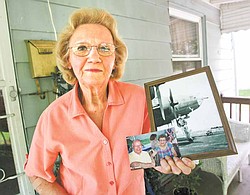
Dixie Lee Kosovec, 75, of McDonald had a World War II bomber named after her, thanks to an uncle, Andy Bugzavich, who fought in the war. After three missions, the bomber was shot down over France.
SEE ALSO: Honoring those who gave all
By Robert Guttersohn
McDonald
While 8-year-old tomboy Dixie Lee played at Warren’s Third Street School in 1944, a B-17 bomber bearing her name was flying over Europe.
Today, Dixie Lee Kosovec, 75 and still lively, keeps shelved in her McDonald home the photo of her uncle Andy Bugzavich leaning on the long propeller blade of the flying fortress he manned. Her name is written above the sergeant in painted script along the nose.
In 1942, so the tale goes, the crew threw into a hat names of what to call their new B-17. Andy threw in his niece’s name, and it was selected.
“The tot now has a flying fortress named after [her], busy cracking the axis,” read an Aug. 20, 1942, newspaper article she has protected in plastic, glued to a browning piece of paper and kept inside a World War II scrapbook.
Years before the war started, Kosovec’s mother and father divorced, and she was raised by her grandparents, Peter and Mary, and lived with her aunt Anne and uncles Alex, Joe and Andy. But the three uncles were brothers to her, particularly Andy whom she grew close to.
After the Pearl Harbor attack, the men left for their military posts, and she remembered waiting excitedly for them to return home on leave, waiting to hear them call her “Babe.”
“The minute they’d hit the drive, I was out on the drive and they’d pick me up,” she said. Andy “was the closest one to me. He was always there.”
Kosovec said their personalities clicked, both easy going.
Andy left for England, and his B-17 was one of thousands that prepped the Normandy coastline for the D-Day invasion. But After three missions, the bomber was shot down over France. For a reason Kosovec cannot recall, Andy was not on the mission.
At that time, young Kosovec had no clue about what it meant to have her name on the bomber.
“It’s quite an honor,” she says now.
During his service, Andy earned a Distinguished Unit Badge, European, African and Middle Eastern ribbons with three bronze battle stars. After the war ended and each was married and had kids, the two continually kept close. There was very little talk about the war, but periodically he’d ask about her scrapbook.
“The kids enjoyed them,” she said. “The grandkids enjoyed them.”
After his wife, Josephine, died, Andy was very lonely.
“I’d constantly go see him,” she said. “I’d call him all the time”
Then tragedy struck. In 2006, at 83, Andy was robbed and beaten in Warren on Comstock Street.
“He was fighting back,” she said. “He was very strong for his age.”
Kosovec said his personality was still there, but his memory and eventually his condition faded. He died a month after the beating. Like the 1942 article that began it, she keeps his obituary in plastic as part of her scrapbook. He’s now buried with Josephine in a Cortland cemetery. Kosovec, his death still striking an emotional chord, still visits him every holiday, laying flowers at his marker.
“I just stand there and pay my respects to him,” she said.