 43
43

Weather continues to cut into outdoor business
RELATED: Rain delays installation of classroom trailers for Austintown schools
By Robert Guttersohn
rguttersohn@vindy.com
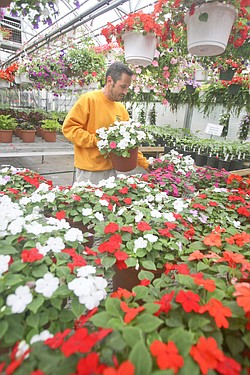
The aisles of Mashorda’s County Gardens on a typical spring day are filled with customers picking plants and flowers.
Rain Economics
 Video
Video
On a typical spring day, the aisles of Mashorda’s County Gardens are filled with customers picking plants and flowers. But as the Valley endures its longest stint of cold, rainy weather in April and May, only a handful perused the Austintown store. “This is the worst start in my fifteen years,” Ray Mashorda, the store owner, said. “And if my dad was living today, it would probably be his worst start in 40 years.” He’s not alone. Across the region, businesses and farmers that rely on a warm, drier spring to boost their sales have fallen behind as the rain continues to saturate soil and discourage consumers.
More Rain In The Valley
 Video
Video
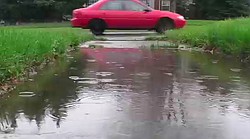
Rain continues to fall in the Mahoning Valley making this Spring one of the wettest on record.
Only a handful perused the Austintown store during a break from the rain, however, as the Valley endures its longest stint of cold, rainy April and May weather.
“This is the worst start in my 15 years,” said store owner Ray Mashorda. “And if my dad was living today, it would probably be his worst start in 40 years.”
He’s not alone. Across the region, businesses and farmers that rely on a warm, drier spring to boost their sales have fallen behind as the rain continues to saturate soil and discourage consumers.
For Mashorda, the biggest challenge is maintaining plant quality as they sit under gray skies.
“It takes a lot to maintain the plants without sun,” he said. He now uses various greenhouse techniques to extend the lives of his plants.
“But somewhere along the line here, if it doesn’t straighten out, then it becomes another step of difficulty,” Mashorda said.
The problem goes beyond the agricultural and horticultural businesses.
Josh Aikens, Home Builders/Remodelers Association executive director, said demand for home improvement has increased since last year.
“People are starting to look at fixing their homes again,” Aikens said.
Yet the region’s home builders are forced to stall their construction because of the mud.
Joe Koch Construction is one remodeling company that has seen an “absolute increase” in demand, said Danielle Jackson, marketing manager. But the company has been forced to delay at least a couple of home-improvement projects.
“We can’t dig deep because when we do, the water fills in the hole,” Jackson said.
The rain also causes logistical problems with heavy equipment.
“We can’t get a backhoe out there because it sinks in,” Jackson said.
The construction company is pushing back its appointments to later in the summer, she said.
Mary Jan Perdulla, co-owner of Pioneer Trails Tree Farm, said she, too, has received an increase in consumer phone calls but is weeks behind because of the weather.
“April was unusually rainy,” Perdulla said. “Now we’re getting hit in May.”
Perdulla worries about the long-term effects the weather will have on trees planted into saturated soil. This could cause root decay, root rotting and additional diseases that will place stress on the trees “that might not show up until late summer,” she said.
For her business, Perdulla primarily relies on a tree nursery in Pennsylvania. But bad weather also hit that state. The nursery, she said, was unable to plant seedlings because fields were saturated.
“They couldn’t get into their area because it was so wet,” Perdulla said.
In addition to local businesses, inclement weather across the country has hit national chains. Lowe’s, the nation’s second-largest home-improvement store, reported Monday a first-quarter loss of 5.7 percent. Robert Niblock, Lowe’s chairman and CEO, attributed at least a portion of the loss to the weather.
Home Depot, the country’s largest home-improvement store, reported Tuesday a loss in sales of 0.2 percent.
“It’s the roller coaster of agricultural life,” David Marrison, agricultural educator for both the Ashtabula and Trumbull County Ohio State University extension centers. “Some years are good, and others, you’re at the mercy of Mother Nature.”
For the most part, Northeast Ohio farmers are forced to delay planting corn and soybeans because of the weather. But Marrison said he is telling them to “hang on,” because they are still in their window.
“Normally, you’d like to see all your corn and soybeans planted by Memorial Day,” he said. “But I don’t think that is going to happen, the way the weather is looking.”
Farmers in this region have waited to plant at the beginning of June in the past but could risk a wet harvest in the fall depending on the type of corn they decide to plant, he said.
Some farmers took advantage of a break in the weather earlier in the month at the risk of having their seeds washed away.
“Is there a risk of drown-out? Absolutely,” he said.
But Marrison was optimistic that June would be a better month for the Valley.
“I’m pretty confident we’ll get a break,” he said.
Until then, Mashorda continues to check the weather “50 times a day” looking for that break. He, too, is looking forward to June.
“I think we are probably going to have a better June than normal,” he said.
Minutes later, rain began to fall again.