 43
43

St. Pat’s centennial May 24
By LINDA M. LINONIS
religion@vindy.com
YOUNGSTOWN
St Patricks 100th Anniversary
 Gallery
- St. Patrick Church centennial ...
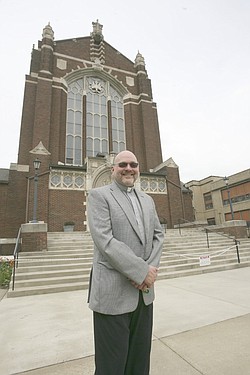
How “Song for World Peace” came to be the finale of the centennial concert planned May 24 at St. Patrick Church, 1420 Oak Hill Ave., is a long and winding story. It’s about family going the extra mile to help out one of its own.
About two years ago, the Rev. Edward Noga said plans were being formulated for the church milestone. There were meetings with Pat Syak, director of Youngstown Symphony Society, and Randall Craig Fleischer, conductor, to make arrangements with Youngstown Symphony Orchestra to present a concert.
Father Noga said Fleischer suggested the church choose six significant dates in its history and he would find music of those eras. Father Noga also made suggestions, including a piece by John Williams, American composer, conductor and pianist who has composed film scores for the Star Wars movies and music from “Jaws,” “Superman” and the Indiana Jones films. Father Noga said he wanted “Song for World Peace” by Williams to close the concert.
There was a stumbling block. The piece was not in print for public use though it had performed as a tribute for a former conductor of the Boston Symphony. Father Noga said he wasn’t deterred and wrote to Williams “to see if he would lend us the score for our anniversary celebration.”
On a trip to San Diego a while ago, Father Noga visited cousins, one of them being Martha Hudak, a former Youngstown resident who now lives in Hollywood, Calif. Father Noga told her he should have asked her to hand deliver the request letter to Williams. She told her cousin to send her a copy and she would.
She did, and the rest will be the finale to the concert.
Father Noga said Williams’ office contacted the church and relayed that and would be “honored to share the music.”
“Song for World Peace” will end the concert that also will include “Fanfare for the Common Man” by Aaron Copland, “Rhapsody in Blue” by George Gershwin and a Duke Ellington tribute arranged by William Holcombe.
The music will be played in the church, where 72 stained-glass windows highlight the structure.
Some concert tickets are available; call the church at 330-743-1109.
Jack Doran, a lifetime member, usher coordinator and a historian, said the church interior features an oak baldachino, which represents a Jewish tent that protected religious scrolls. He added that 72 stained-glass windows, all refurbished, illuminate the interior’s crucifix (cross-like) design.
Bill Crawford, lifelong member and a church historian, said a variety of vintage photos of the church will be featured May 22 through the month of July at the Arms Museum on Wick Avenue.
St. Patrick Church, 1420 Oak Hill Ave., Youngstown, is celebrating its centennial with a series of events that began in January and will conclude in October. Highlights this month are: May 22, a 10 a.m. Mass with Bishop George Murry, and May 24, from 6:30 to 8:30 a.m. free coffee and donuts on Market Street in honor of the 100th year and at 7 p.m., a performance by the Youngstown Symphony Orchestra at the church followed by a reception.
The beginning: In 1911, Bishop John P. Farrelly of the Cleveland Diocese, of which Youngstown was then a part, established a new parish, St. Patrick Church, on the city’s South Side. The Rev. Charles A. Martin was first pastor. Father Martin offered the first Mass of the newly established parish on Pentecost Sunday, June 4, 1911, in St. Columba Church hall. As a temporary residence, he rented a six-room frame house on the southeast corner of Cleveland Street and Oak Hill Avenue for $18 a month. Here, daily Mass was offered. The house, which still stands, was sold in 1991 to CHOICE, a local housing- rehabilitation program, with some help from the parish and St. Vincent de Paul Society. Groundbreaking for the present rectory was in the spring of 1912; an addition and garage were added eight years later. The structure was remodeled in 1990; the entire cost of the project was a gift from a parish benefactor.
Church building: Property was bought in June 1911, and a California-style mission semi-permanent church was erected in five months, free of debt and dedicated Nov. 12, 1911, by the Rev. Edward Mears, pastor of St. Columba. Plans for a permanent church of Gothic design were begun in the early 1920s under Father Martin, who was transferred in 1922. Plans were continued by the new pastor, the Rev. Edward A. Mooney. He served just three months when he was appointed spiritual director of North American College in Rome, Italy. He was later named archbishop of the Detroit Diocese and elevated to cardinal. The building of the new permanent church progressed under the new pastor, the Rev. William A. Kane, with the groundbreaking in 1923. The cornerstone was laid in 1924; the permanent church was dedicated in 1926.
Activities: Under Father Kane, the St. Patrick Parish Camp at Lake Milton was started, later renamed Father Kane Camp, and eventually operated by the Catholic Diocese of Youngstown. Father Kane, was named monsignor Dec. 23, 1934, and died Nov. 10, 1937. The Our Lady of Miraculous Medal Novena began in 1933 with about 10 weekly devotions on Monday, and continues today with one weekly service at 8:30 a.m. Mondays.
Leaders: The Rev. Maurice J. Casey, who succeeded Monsignor Kane as pastor in 1938, became a monsignor in 1948 and died in 1952. Monsignor Alfred J. Heinrich, chancellor of the diocese, was appointed pastor in 1952 and died in 1964.
Special honor: St. Patrick Church was designated the pro-cathedral when St. Columba Cathedral was destroyed by fire in 1954.
1960s and ’70s: The Rev. Arthur DeCrane succeeded Monsignor Heinrich in 1964, and Monsignor P. Breen Malone was pastor from 1967-79. The Rev. Vincent J. Lisi became pastor in 1979. He initiated an Education Development Fund for financial assistance for the school, and planned and executed a successful capital fundraising campaign, the St. Patrick Restoration and Preservation Campaign, in 1983 to secure a minimum of $300,000. Father Lisi resigned in 1985; the Rev. Edward P. Noga was appointed pastor.
Improvements: Under Father Noga, the longest resident pastor, there have been many changes. Several pews in the rear of the church were removed to create a gathering space, and the original baptismal font was placed near the front entrance of the church. The organ and baby grand piano, along with space for the choir, was moved into the main body of the church. The slate roof was replaced debt-free, and a hand-crafted gutter system was completed. A new oak altar, lectern and ambo were made and designed by a parishioner and modeled after the original baptismal font.
Restoration project: In May of 2001, a major restoration project of the interior of the church began. All 72 stained- glass windows were cleaned, broken glass and lead replaced and covered with clear plastic. Brick and sandstone walls were pressured washed and the ceiling was washed and refinished. The oak floor was sanded and re-stained and all pews were cleaned and varnished then placed farther apart to allow for more space between each pew. Six inserts were put into place for wheelchair accessibility. All light fixtures were cleaned and chains and wiring were replaced along with ceiling fans. The ceiling in the sanctuary above the baldachino was cleaned and repainted. The cost of $300,000 was totally paid for by parishioners, contributors, foundations and friends of St. Patrick. The church hall was used for Masses and within six months, the congregation returned to a completely cleaned and restored main church.
2000s: In 2005-06, a new stairway was placed in the boys’ sacristy from the main church to the church hall. An elevator was installed between the doors by the south entrance and the church proper for handicap access to the church hall. In 2006, St. Patrick parking lot on Cleveland Street and Oak Hill Avenue was enlarged and extended over to Kenmore Avenue, adding 40 parking spaces.
Source: St. Patrick Church