 43
43

Students inspired by balloon power
The Vindicator
 Photo
Photo
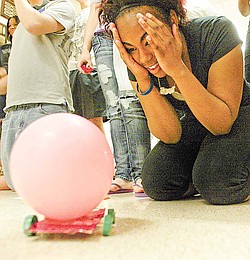
Paige Saunders, 15, a ninth-grader in Joe Slifka’s physical science class at Liberty High School, reacts to the performance of “Lola,” the nickname of the team’s balloon-powered race car, Wednesday. The goal of the project was for students to see the practical side of Newton’s laws of motion. Students designed and built cars powered by air in a balloon.
By LINDA M. LINONIS
LIBERTY
The balloon-powered cars made by students might not look like much, but they teach a lot.
Students assembled balloon-powered race cars with odd lots such as plastic bottle caps or old CDs for wheels and plastic foam, balsa wood or cardboard as the body.
About 130 students in Joe Slifka’s physical-science classes at Liberty High School are participating in the balloon-powered race car project. Slifka challenged students, who work in teams of three or four, to design and construct a race car that incorporates Newton’s laws of motion.
For those whose science is fuzzy, those laws are: an object at rest stays at rest and an object in motion remains in motion unless acted upon by an unbalanced force, force equals mass times acceleration, and for every action there is a equal and opposite reaction. The goal is for students understanding how to use the formula of speed equals distance divided by time.
Slifka said the project encourages students “to be innovative, use creative thinking and develop problem-solving skills.” “I think the project is interesting to students because it’s more about real-world problems. When they have a personal stake in their education, it becomes more valuable,” he said.
For example, he said, students wondered why some cars easily moved on the classroom floor but encountered difficulty on hallway floors. That led to a discussion about friction ... and the wax on each surface.
Slifka said the students must use math, science and engineering ideas to design and build a car. They have to figure out how to attach a straw or hollowed-out pen to the car and balloon, which provides the propulsion. A daily journal also is part of the process and puts English skills to use. There are a few rules including the wheels can’t be from a toy car.
The teacher said he believes the race car project also helps “create a positive relationship” among students and with him as their teacher.
Slifka said he also sees the project as one that helps students hone skills to collaborate as a team and exchange ideas.
The races determine the fastest car ... the one that covers one meter (three feet) the quickest, and the one that travels the farthest. There are awards for those and the lightest car; Slifka makes the prizes with toy cars.
The races take place after the students learn the material. “It’s a reward,” Slifka said. Five races determine an average for each car.
As for the students, it was apparent they were engaged in the project. Paige Saunders, 15, said her team’s car nicknamed “Lola” did well in the classroom but not so good in the hallway. She said she “enjoyed working with the group” and exchanging ideas.
The ninth-grader said the project showed her the importance of teamwork.
Nathan Derenzis, 16, said he liked learning about Newton’s laws of motion and how they applied to cars in general. “The team had ups and downs but we worked together to fix the car,” he said. The freshman added that he appreciated hearing ideas from other students.