 43
43

Floodwaters rise in Mississippi
AP
 Photo
Photo
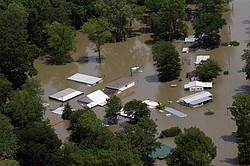
Houses and property along the Mississippi River near Tunica, Miss., are flooded by the Mississippi River, Wednesday, May 11, 2011. Gov. Haley Barbour and other officials took an aerial trip along the Mississippi River and some of its tributaries to view the spreading damage from the flood waters.
Associated Press
RENA LARA, Miss.
Floodwaters from the bloated Mississippi River and its tributaries spilled across farm fields, cut off churches, washed over roads and forced people from their homes Wednesday in the Mississippi Delta, a poverty-stricken region only a generation or two removed from sharecropping days.
People used boats to navigate flooded streets as the crest rolled slowly downstream, bringing misery to poor, low-lying communities. Hundreds have left their homes in the Delta in the past several days as the water rose toward some of the highest levels on record.
The flood crest is expected to push all the way through the Delta by late next week.
“It’s getting scary,” said Rita Harris, 43, who lives in a tiny wooden house in the shadow of the levee in the Delta town of Rena Lara, population 500. “They won’t let you go up there to look at the water.”
Officials in the town, which has no local newspaper or TV stations, tried to reassure residents that they are doing what they can to shore up the levee and that they will warn people if they need to leave.
Mississippi Gov. Haley Barbour urged people to get out if they think there is even a chance their homes will flood. He said there is no reason to believe a levee on the Yazoo River would fail, but if it did, 107 feet of water would flow over small towns.
“More than anything else, save your life, and don’t put at risk other people who might have to come in and save your lives,” he said.
The Mississippi Delta, with a population of about 465,000, is a leaf-shaped expanse of rich soil between the Mississippi and Yazoo Rivers, extending about 200 miles from Memphis, Tenn., to Vicksburg, Miss. Along the way are towns whose names are familiar to Civil War buffs, aficionados of the blues and scholars of the civil-rights era: Clarksdale, Greenwood, Greenville and Yazoo City.
Though some farms in the cotton-, rice- and corn-growing Delta are prosperous, there also is grinding poverty. Nine of the 11 counties that touch the Mississippi River in Mississippi have poverty rates at least double the national average of 13.5 percent, according to the U.S. Census Bureau.
The governor said the state is asking local officials to get in touch with people who might have no electricity and phones and thus no way to get word of the flooding.
“It’s a tiny number, but we have to find them,” Barbour said.
In Greenville, Liz Jones, who is unemployed, lives on the second floor of a housing project and worries what might happen in the event of a levee break. She has no means of transportation.
“I got a baby and my mama. I don’t know what we’d do about food and clothes and stuff,” she said.
In Hollandale, one of the small, rural towns in the Delta that the governor warned might flood if the levee breaks, 62-year-old nursing-home worker Geraldine Jackson fretted about what to do if she and her husband have to leave their red-brick house, where pieces of the roof have broken off and the white trim is peeling.
“I have relatives, but all my relatives live in the Delta, and the water’s going to get them too,” she said. “I’m just real messed up.”
Swollen by weeks of heavy rain and snowmelt, the Mississippi has been breaking high-water records that have stood since the 1920s and ’30s. It is projected to crest at Vicksburg next Thursday and shatter the mark set there during the cataclysmic Great Flood of 1927. The crest is expected to reach New Orleans on May 23.