 43
43

New Warren plant to treat water from Marcellus Shale
The Vindicator
 Photo
Photo
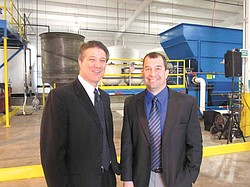
Tom Angelo, Warren water-pollution control director, left, stands with Andrew Blocksom of Lisbon, owner of Patriot Water Treatment, inside Patriot’s water-treatment plant on Sferra Avenue Northwest in Warren Commerce Park. The company had a ribbon cutting and showed how the plant removes salt, metals and solids from water coming from Marcellus-Shale drilling operations.
Treating water
The process Patriot Water uses to treat water fromnatural-gas-drilling of the Marcellus Shale:
Tanker trucks entering the Warren facility of Patriot Water undergo two types of sampling to determine the amount of alkalinity, dissolved solids, and salt in the water. Water that is flammable, contains too much alkalinity or any petroleum is turned away.
If levels are acceptable, the water is removed from the tankers — as many as five at a time — into a collection tank.
The water is transferred to a large holding tank.
It is piped into the plant, where it enters settlement tanks. The solids are removed to a landfill.
Water is piped into a clarifier tank that removes suspended solids and metals and adjusts the alkalinity.
The treated water enters sanitary sewers and travels to Warren’s wastewater treatment plant on the other end of town on South Main Avenue, where it is treated again and allowed to enter the Mahoning River.
Source: Jeff Faloba, Patriot Water operations manager
By Ed Runyan
WARREN
Patriot Water Treatment may employ only 10 people at its new Warren facility now, but growth could lead to 400 such Northeast Ohio jobs in the next 12 to 16 months, Warren Mayor Michael O’Brien said Tuesday.
Patriot’s treatment plant, built to accept wastewater from natural-gas-mining operations in the Marcellus Shale region, also is likely to be a part of the local landscape for generations to come.
“The opening of this facility marks the start of an important, emerging industry not only for Warren but Northeast Ohio,” O’Brien said.
The Marcellus Shale is a huge deposit of natural gas in eastern Ohio, Pennsylvania and New York.
“This project has the potential of providing our Valley’s work force with jobs for two to three generations — jobs that cannot be outsourced to a different state or country,” O’Brien added.
O’Brien and others attended a ribbon-cutting ceremony at Patriot’s 4-month-old facility on Sferra Avenue Northwest in Warren Commerce Park, off of North River Road.
The company employs five people at its corporate offices in Lisbon and is looking to add 15 more workers in the next three months, said Andrew Blocksom of Lisbon, president of Patriot Water Treatment.
O’Brien said the start-up of Patriot Water, the first Ohio plant established to treat water from the Marcellus Shale, is exciting because so many of the catch phrases of our nation’s future can be used to describe it — reducing dependency on foreign energy, American made, American produced and going green.
Blocksom invited the mayors of Steubenville and East Liverpool to the ribbon cutting because Patriot Water will open similar facilities in those communities soon as well.
The city of Warren and Patriot took the idea to the Ohio Environmental Protection Agency to establish this type of facility in May 2009 and have been working on it since, said Tom Angelo, Warren’s water-pollution control director.
The EPA approved the plant to accept 100,000 gallons of wastewater per day. After Patriot treats the water, it enters the sewage system and travels to the city’s wastewater treatment plant for further treatment before entering the Mahoning River.
The city and company are working with the EPA to increase the amount of water accepted to 300,000 gallons per day.
The city is on pace to earn about $100,000 in revenue per year as a result of Patriot’s current operations.
The plant accepts water from as few as a handful of trucks to as many as 40 in a day and has processed 4.365 million gallons worth so far, said Jeff Faloba, operations manager.
If the company is approved for 300,000 gallons per day, that would be the equivalent of about 60 tankers per day, he said.