 43
43

Honoring the fallen
The Vindicator
 Photo
Photo
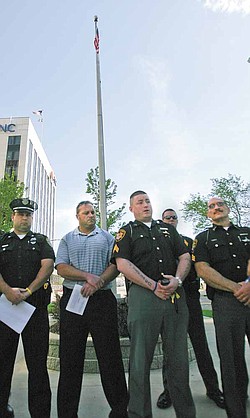
Local police and firefighters gathered in downtown Youngstown to honor officers killed in the line of duty. They are, from left, Youngstown Police Officer Sam Mosca; Christopher Weaver, Youngstown Professional Firefighters union; Sgt. T.J. Assion, Mahoning County Sheriff’s Department and president of Fraternal Order of Police Lodge 141; and Sgt. Salvatore Pascarella from the sheriff’s department. Monday’s event was part of National Police Memorial Week, but the gathering also focused attention on the new Ohio law that limits collective-bargaining rights of public employees like police officers and firefighters.
 Photo
Photo
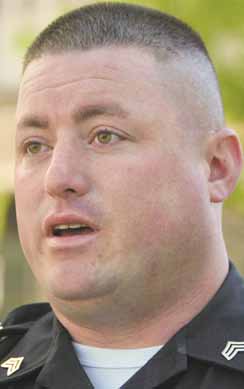
Sgt. T.J. Assion of the Mahoning County Sheriff’s Department
National Police Memorial Week was established in 1962
YOUNGSTOWN
About a dozen area police officers and firefighters gathered to honor fallen officers, but a vocal opposition to Senate Bill 5 was a big part of the remembrance.
The local observation took place Monday on Central Square in downtown Youngstown, the first day of National Police Memorial Week. President John F. Kennedy established the memorial week in 1962 as a way to remember police officers killed in the line of duty.
In 2010, there were 158 police officers killed in the line of duty nationally, with four of those officers coming from Ohio. Thus far, there have been 66 officers killed in 2011 nationally with five from Ohio.
Sgt. T.J. Assion of the Mahoning County Sheriff’s Department, president of Fraternal Order of Police Lodge 141, said there has been an 88 percent increase in officers killed by gunfire over the last year.
The last Mahoning County officer to die in the line of duty was Youngstown Patrolman Michael Hartzell on April 29, 2003.
Assion said it is important to recognize and honor those officers who have been killed serving the community. Loss of life, he said, is a reality police officers face everyday going to work.
“When someone loses a life protecting the community it affects us all so profoundly,” he said. “There aren’t too many jobs where you go to work not knowing if you are coming home. That is what we go through everyday.”
Assion said many members of law enforcement have pondered whether it is appropriate to include the fight against Senate Bill 5 in the remembrance of fallen officers, but he said the two issues are tied together.
The Senate Bill 5 legislation restricts collective bargaining among state employees and workers at state colleges and universities. Current collective-bargaining agreements would expire at the end of their current terms, and future employee pay rates and increases would be based on merit, not seniority.
“We thought long and hard about do we want to tie in members of fallen officers with a political agenda, but [when] we talk about collective bargaining there are a lot of things in our contracts that ensure our safety,” he said. “We accept that when we kiss our wives goodbye in the morning we may never see them again, but we negotiate things in our contracts to minimize that.”
Assion called the new legislation disrespectful to the memory of officers who died in the line of duty.
Officer Sam Mosca of the Youngstown Police Department said the statewide effort to get the legislation to the ballot is in full swing and well-received by the local and state community. He said there are 10,000 people across the state collecting signatures.
“We have gotten a great response from the people of this community. People understand that labor unions were a big part in the building of this community,” he said. “People understand that this [SB 5] is bad policy.”