 43
43

Economic talks
ASSOCIATED PRESS
 Photo
Photo
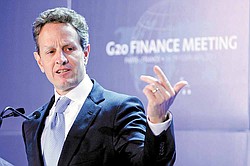
FILE - In this Feb. 19, 2011, file photo U.S. Treasury Secretary Timothy Geithner answers questions at the closing press conference of the G20 Finance summit in Paris. Five years and one financial crisis since the United States and China commenced regular high-level economic talks, fast-growing Beijing might have the upper hand Monday, May 9, 2011, in the latest round of discussions between the world's two biggest economies. While analysts don't foresee major breakthroughs at the talks Monday and Tuesday, China's expanding economic might will give it greater leverage now.
China may have upper hand against US
Associated Press
WASHINGTON
Five years and one financial crisis since the United States and China began regular high-level economic talks, fast-growing Beijing might have the upper hand this week in the latest round of discussions between the world’s two biggest economies.
China faces threats of penalties against goods shipped to its largest foreign market unless it does more to end what U.S. manufacturers say are unfair trade practices, including currency manipulation, that have cost American jobs.
At the same time, America’s biggest foreign creditor wants assurances that its $1.2 trillion in U.S. Treasury holdings are safe despite uncertainty in Washington over how much money the U.S. can borrow to pay its bills. If Congress fails to increase that borrowing limit before August, that probably would send interest rates soaring and reduce the value of those Chinese investments.
Though analysts don’t foresee major breakthroughs at the talks today and Tuesday, China’s expanding economic might will give it greater leverage now.
“The focus has shifted to making methodical if slow progress,” possibly reflecting a maturing relationship between the two nations, said Eswar Prasad, a China expert at Cornell University.
Leading the Obama administration’s delegation at the Strategic and Economic Dialogue are Treasury Secretary Timothy Geithner and Secretary of State Hillary Rodham Clinton. Federal Reserve Chairman Ben Bernanke and officials from 16 federal agencies are attending, too.
The Chinese team is headed by Vice Premier Wang Qishan, a top economic policymaker, and includes officials from 20 government agencies.
The talks began during the Bush administration in 2006. Under President Barack Obama, they’ve broadened to cover foreign policy as well.
The main U.S. economic goal hasn’t changed: prodding China to move faster to let its currency rise in value against the dollar. That would make U.S. exports cheaper in China and Chinese products more expensive in the United States. It also would help narrow America’s trade deficit with China, its largest with any country.
When the talks started, Treasury Secretary Henry Paulson, a former head of Goldman Sachs, lectured Chinese officials on how much better their economy would perform if they eased controls on their currency and financial markets.
But the Chinese emerged from the global financial crisis in better shape than other economic powers, largely because of their highly regulated markets. In doing so, and in growing far faster than the U.S., Beijing has gained economic influence.
“The global financial crisis changed the dynamic of the relationship substantially,“ said Nicholas Lardy, a China expert at the Peterson Institute of International Economics. ”It increased China’s confidence on economic issues.“
Though Geithner said last week that the U.S. would press China to accelerate efforts to revalue its currency, the yuan, he also sounded a conciliatory tone. He noted that the yuan has risen in value by 5 percent since last June, and even faster once inflation was taken into account.
Geithner said it was encouraging that Beijing was starting to endorse the U.S. view that a faster appreciation of the yuan would help China choke off inflation, which the country’s escalating growth has stoked.