 43
43

YSU student goes to great lengths to save girls at China’s Great Wall
The Vindicator
 Photo
Photo
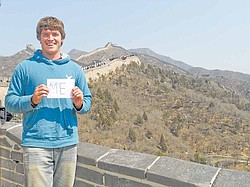
When Youngstown State University senior Erik Johnson booked his Semester at Sea, little did he know a night on the Great Wall of China would turn into a life-saving memory.

The Vindicator
Photo
When Youngstown State University senior Erik Johnson booked his Semester at Sea, little did he know a night on the Great Wall of China would turn into a life-saving memory.
By Denise Dick
BOARDMAN
When Youngstown State University senior Erik Johnson booked his Semester at Sea, he never imagined he’d be putting his limited medical skills to use.
Johnson, 22, who will graduate later this month, majored in biology at YSU. He finished his coursework early and decided to end his college career spending 104 days visiting 11 countries through the Semester at Sea program. He was the only YSU student on the trip.
He starts dental school at The Ohio State University this fall.
One of the countries visited earlier this year was China, and students took a trip with a separate company to sleep on the Great Wall.
“There are no lights,” Johnson said. “They give you these small flashlights. The wall is really steep at some points.”
Two girls were walking along the wall, didn’t see the steps because of the darkness and fell about 30 feet to the ground below.
Johnson didn’t see them fall but wanted to help.
“I’ve had very little medical experience,” he said. “My dad is a dentist, and I’ve done some sports medicine. I’ve seen the basics.”
When he arrived at the scene, he saw a lot of blood. One girl suffered a knee injury — skin ripped away so the kneecap was visible. The other girl though, a native of Chicago, hit her head.
“She could answer questions basically with moans and groans,” Johnson said.
He knew she was in bad shape.
He and some other students unhinged a door from the wall and used it as a stretcher to carry the girl three-quarters of a mile down the road, taking care to stabilize her head. From there, they helped load her into a van and take her to the nearest hospital — a small, rural facility about 45 minutes away.
“The doctor came out, leaned his head down to listen to her breathing and said that it was fine and that was all he could do for her,” Johnson said.
He knew the girl needed more than that. She was nonresponsive. The closest big hospital was in Beijing, about 2 1/2 to 3 hours away, and the small hospital’s ambulance was broken.
They would have to drive her there in the tour company van.
The doctor at the first hospital even hesitated to give Johnson gauze so he could dress the other girl’s knee wound.
While on the drive, the girl’s condition deteriorated. She began foaming at the mouth and seizing.
Johnson called his father, dentist Dr. Robert Johnson, who advised him to call Dr. Scott Agnew. Dr. Agnew had spent time in Haiti, Dr. Johnson said, and has perspective on providing medical care under rudimentary conditions.
Dr. Agnew told him that if he was concerned about the girl’s breathing, he could move her onto her side while continuing to stabilize her head, Johnson said.
He also contacted the hospital in Beijing, alerting doctors to her arrival.
They finally arrived at the Beijing hospital, where doctors determined she needed oxygen, but before doctors would administer any care, they required payment.
It was about 3 a.m., so the hospital’s administrative offices were closed and the doctors wouldn’t accept the girl’s insurance.
Johnson had left his belongings on the Great Wall. One of the girl’s friends found her credit card and used that, and the doctors gave her oxygen.
“She was in a coma at that point,” he said.
She started foaming at the mouth again, and Johnson urged the doctor to turn her on her side. The doctor argued that she was fine. She started to have a seizure, and the doctors placed her on a ventilator. Johnson called both of her parents, urging the girl’s mother to come to Beijing.
The girl needed a brain scan, but the hospital needed payment first.
When the hospital required $6,000 before putting the girl in intensive care, he had to ensure with her father that her credit card would cover it.
He had to sign off on all of the treatments.
“It really gave me an appreciation for the American health-care system,” Johnson said.
The girl had bleeding in part of her brain.
He held the other girl’s hand while doctors sewed 29 stitches into her injured knee.
About 9 a.m., after the girl was stabilized, her mother was on a plane, and doctors from Semester at Sea arrived at the hospital.
Johnson was concerned about being left behind by the tour company, so he and another student who had spent the night at the hospital returned to the wall.
“Her parents told the doctors that they were very grateful and that she owed us her life,” he said.
He continued the trip and returned home late last month. He’s learned through the Semester at Sea program that the injured girl spent time in a Hong Kong hospital before more treatment in the United States. She is undergoing rehabilitation in a New York facility.
He hasn’t spoken to her or her family since the ordeal.
Dr. Johnson is proud of his son, but the young man isn’t sure how he maintained composure throughout that night.
“I was very calm that whole time,” he said.
God must have had a hand in it, Johnson reasons.