 43
43

Healthier Options in school vending machines
The Vindicator
 Photo
Photo
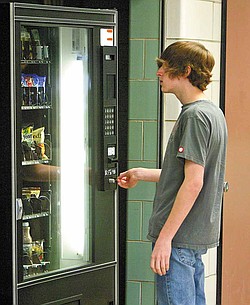
Will Kooyman, a junior at Boardman High School, puts money in one of the school-owned snack vending machines in the cafeteria. Public health and school offi cials are on a mission to reduce calories and improve nutrition of items sold to students in Mahoning County schools.
The Vindicator
Photo
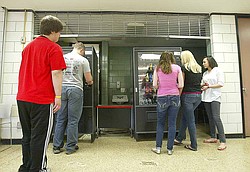
Lines form at the snack and beverage machines during the lunch hour at Boardman High School. A 2010 survey of school vending machines by the Mahoning County District Board of Health found overall a significant increase in healthier options but no improvement in vending-machine snack choices.
AUSTINTOWN
Mahoning County public health and school officials embarked on a mission that might have seemed impossible a decade ago: improving the nutrition of vending-machine options for students.
It appears they are succeeding — at least with drinks.
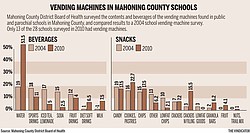
Over the last 10 years, healthier drink options in school vending machines increased dramatically, but the percentage of nutritious snack choices remained about the same, said Matthew Stefanak, commissioner of the Mahoning County District Board of Health.
The county health board recently issued the findings of its 2010 survey on vending-machine contents in 28 county schools with 15,024 students enrolled. Sixteen of the schools were elementary buildings, and six each were middle and high schools. Only 13 of the 28 schools had vending machines.
The full report, “Healthier Choices in School Vending Machines: Survey Results from Mahoning County Schools,” can be found online at www.mahoninghealth.org. The report is a follow-up to similar surveys done in 2000 and 2004.
Overall, surveyors found a significant increase in healthier vending-machine beverage options, such as water, milk, or pure fruit juice, between 2000 and 2010.
There has not been a corresponding improvement, however, in the nutritional value of vending-machine food options.
Possible reasons are that fresh fruits and vegetables have a limited shelf life and that students don’t buy them, Stefanak said.
At Boardman High School, students accepted the more nutritious snacks in the machines within a couple of weeks, but the fresh fruits and vegetables did not sell well, said Karen Sanders, the school district’s food-service supervisor.
Sanders said Boardman has worked since 2006 to change the guidelines for the food it serves by eliminating carbonation and unnecessary calories yet still serve something that was acceptable to the buyers.
For example, she said candy bars were removed and replaced with more nutritious items such as granola bars, yogurt, chocolate milk, water, sports drinks and string cheese, which do sell well.
Boardman students said, in general, that they like the vending-machine offerings.
Will Kooyman, a junior, said he buys snacks and said they are OK. Nida Imtiaz, a senior, and Ricky Avers, a sophomore, said the vending-machine food is good.
Corey Fonner, also a sophomore, said he usually buys water or a sandwich from the machines.
“We can say the options in the schools are healthier than they were before 2006, but there are other options outside of school that we can’t control. Everything we sell in the cafeteria adheres to dietary guidelines and are age-appropriate,” Sanders said.
Boardman may have an advantage that some other schools may not: The school district owns the vending machines and has control of what is put into them.
Stefanak said it is important to monitor the nutritional value of foods and drinks served in schools for health reasons and because parents are increasingly concerned about what their children are eating, as are the students themselves.
Schools are voluntarily working with vending-machine operators and food suppliers to make things more nutritious and items that contain fewer calories and less sodium, he said.
“Childhood obesity is an important public health issue, and our schools have come a long way in assuring that kids have healthy food choices,” Stefanak added.
Also, he said recent state and federal policy changes will lead to further improvements and “more steps will take place in the near future.”
For example, last year the Ohio Legislature passed Senate Bill 210, known as the Healthy Choices for Healthy Children’s Act, which restricts the sale of certain foods and beverages to students.
Also last year, the federal Healthy, Hunger-Free Kids Act was passed that will develop nutritional guidelines for a la carte items, vending machines and school stores and will make nutritional information more accessible to parents, Stefanak said.