 43
43

YSU student answers the call to study chickadees at parks
The Vindicator
 Photo
Photo
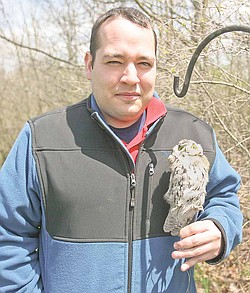
Jacob Saborse, a graduate student at YSU from Austintown, is conducting a park-authorized study of black-capped chickadees in Mill Creek Park. Here, he holds a stuffed screech owl.
By Elise Franco
YOUNGSTOWN
Jacob Saborse began studying the warning call of black-capped chickadees in December, hoping to learn more about the birds’ culture.
Saborse, 24, of Austintown, is a biology graduate student at Youngstown State University who said he’s been working in parts of Mill Creek MetroParks, Berlin Lake, Beaver Creek Park and Mosquito Lake Park, catching the birds and recording their calls.
The chickadees are one of the most common species of forest-edge birds in the area, he said.
The number of “D notes” at the end of the call dictates how threatened the bird feels, Saborse said.
“I present them with a stuffed screech owl, and they produce the call,” he said. “They average 2.05 D notes in Mill Creek Park and 4.5 in Beaver Creek.”
Saborse said this means chickadees in Mill Creek feel less threatened by the presence of the screech owl than they should, likely because the owl is less common there than in other study sites.
“Birds have culture, so they learn calls from other members of their species,” he said. “I’m learning that they’re not learning the warning call where there aren’t screech owls.”
Dr. Ian Renne, associate professor of biological sciences at YSU, said the goal of the study is to use the chickadee as a “model for looking at the cultural breakdown of avian alarm calls.”
“These calls have survivorship value, and in areas that have historically lacked Eastern screech owls, we have been seeing an actual breakdown of those learned alarm calls,” he said. “This may compromise survival.”
Renne said Saborse is using the chickadee as an example for other populations that are becoming isolated.
“Other species are known to lose vocal repertoire when isolated,” he said. “That can exacerbate their decline.”
Saborse said he catches the birds by hanging wire cages on hooks at the outskirts of forest areas within the parks. He puts food inside the cages, and the birds go in after it but have no way out.
“Once I catch the birds, I put a sheet over the cage to let them calm down,” he said. “Then I take the sheet off and show them the owl. Basically it scares them, and they make the warning call.”
Saborse said he records the calls then sets the birds free. So far he’s analyzed warning calls from 11 birds.
To conduct the study, Saborse said he had to get federal Fish and Wildlife and Ohio Scientific Collection permits and was approved by The Institutional Animal Care and Use Committee.
He said his research ends Friday, and he’ll begin working on a paper that he hopes will be published in a journal to be reviewed by his peers.
“For him, peer review in a publication is certainly a mark of scholarship and evidence than one can perform research of high quality,” Renne said.