 43
43

Missouri to court: Block levee blast and farm flooding
AP
 Photo
Photo
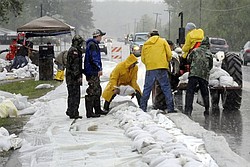
Volunteers hastily work to build a wall of sandbags along Illinois 3 on Sunday, May 1, 2011 in Olive Branch, Ill. Rising floodwaters were only inches from spilling over the opposite side of the highway. Residents hoped the wall would protect homes adjacent to the road, many of which are already surrounded by water on three sides.
Associated Press
CAIRO, Ill.
A legal fight over whether the Army Corps of Engineers should blast open a levee to relieve the rain-swollen Mississippi River went to the nation’s highest court Sunday as the Illinois town at risk of flooding was cleared out.
As Missouri asked the U.S. Supreme Court to block the corps’ plan, struggling Cairo near the confluence of Ohio and Mississippi rivers resembled a ghost town. Illinois National Guard troops went door to door with law enforcers to enforce the mayor’s “mandatory” evacuation order the previous night.
Meanwhile, President Barack Obama declared a major disaster for parts of Tennessee because of the killer tornadoes and flooding.
The order on Sunday means residents in Bradley, Greene, Hamilton, and Washington counties will be eligible for federal funding to help with home repairs, temporary housing, uninsured property losses and other needs. Money will be available for state and local governments as well.
In Cairo, about 20 to 30 families were allowed to stay — a courtesy extended only to adults — after signing waivers acknowledging that they understood the potential peril, National Guard Sgt. 1st Class Heath Clark said.
Maj. Gen. Michael Walsh, the Corps officer in charge of deciding whether to breach the levee, on Sunday ordered field crews to move barges to the Missouri side of the river and begin loading pipes in the levee with explosives in anticipation of blowing up a 2-mile section just downriver from Cairo. He stressed that the decision has not been made.
Walsh said it would take 20 hours to get the pipes filled, during which time he will review conditions. Destroying the levee would provide a relief valve to ease the menacing rivers and ultimately lower them, taking pressure off Cairo’s floodwall and other levees father south along the Mississippi.
The plan possibly would inundate 130,000 acres of now-evacuated farmland in Missouri’s agriculture-reliant Mississippi County, causing what Missouri argues would crush that region’s economy and environment by rendering that cropland useless under potentially feet of sand and silt.
Missouri Attorney General Chris Koster, whose bid to derail the corps’ plan in recent days included failed requests to a federal district judge and an appellate court, took the case to the U.S. Supreme Court, noting “it is the responsibility of this office to pursue every possible avenue of legal review.”