 43
43

Breach possible at Japanese power plant
ASSOCIATED PRESS
 Photo
Photo
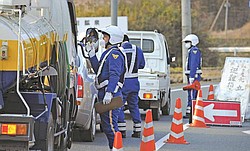
Police officers advise drivers to take a diversion at a checkpoint in Iwaki City in Fukushima Prefecture, at the 30 kilomters (20 miles) point from the tsunami-crippled Fukushima Dai-ichi nuclear power plant, northeastern Japan.
Associated Press
TOKYO
A possible breach at Japan’s troubled nuclear plant escalated the crisis anew Friday, two full weeks after an earthquake and tsunami first compromised the facility. The development suggested radioactive contamination may be worse than first thought, with tainted groundwater the most-likely consequence.
Japanese leaders defended their decision not to evacuate people from a wider area around the plant, insisting they are safe if they stay indoors. But officials also said residents may want to voluntarily move to areas with better facilities, since supplies in the tsunami-devastated region are running short.
The escalation in the nuclear-plant crisis came as the death toll from the quake and tsunami passed 10,000 on Friday. Across the battered northeast coast, hundreds of thousands of people whose homes were destroyed still have no power, no hot meals and, in many cases, no showers for 14 days.
The uncertain nuclear situation again halted work at the Fukushima Dai-ichi complex, where authorities have been scrambling to stop the overheated facility from leaking dangerous radiation. Low levels of radiation have been seeping out since the March 11 quake and tsunami knocked out the plant’s cooling system, but a breach could mean a much-larger release of contaminants. The most-likely consequence would be contamination of the groundwater.
“The situation today at the Fukushima Dai-ichi power plant is still very grave and serious. We must remain vigilant,” a somber Prime Minister Naoto Kan said. “We are not in a position where we can be optimistic. We must treat every development with the utmost care.”
The possible breach in the plant’s Unit 3 might be a crack or a hole in the stainless-steel chamber of the reactor core or in the spent-fuel pool that’s lined with several feet of reinforced concrete. The temperature and pressure inside the core, which holds the fuel rods, remained stable and was far lower than what would further melt the core.
Friday marked two weeks to the day since the magnitude-9.0 quake triggered a tsunami that flattened cities along the northeastern coast. With the cleanup and recovery operations continuing and more than 17,400 listed as missing, the final number of dead was expected to surpass 18,000.