 43
43

Black babies at twice the risk of whites for death, study indicates
MCT
 Photo
Photo
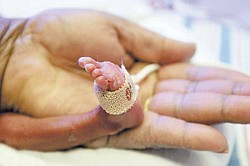
Nurse Rowena Lamont holds the foot of a three-day-old premature baby, born at 6 months, at St. Joseph's Regional Medical Center in Paterson, New Jersey.
McClatchy Newspapers
HACKENSACK, N.J.
African-American women are significantly more likely to lose a baby in the first year of life than white women, in an enduring medical mystery.
It exists at all income and education levels, but is widest among more affluent, highly educated women.
A college-educated black woman in the United States is more likely to lose her baby than a white woman with only a high school education. A black woman who starts prenatal care in her first trimester is more likely to lose her baby than a white woman with late or no prenatal care. A black woman who does not smoke has worse birth outcomes than a white woman who smokes.
The gap between blacks and whites persists despite a marked decline in overall infant mortality in the past two decades, especially in New Jersey.
“Race in America puts your pregnancy at risk,” says Ilise Zimmerman, CEO of the Northern New Jersey Maternal-Child Health Consortium in Paramus, where the nation’s first Black Infant Mortality Reduction Resource Center was founded in 1999.
“It’s not about poverty. It’s not about teenage pregnancy. It’s not about use of drugs. ... If you self-identify as black, there’s a greater chance your baby will be born before full term and be too small.”
Nearly 600 babies in New Jersey died before their first birthday in 2007, the most recent year for which figures are available. Of these, 194 were black and 180 were white, even though black women accounted for only one in eight births. For every 1,000 live births in the state, 11.2 black babies and 3.4 white babies died.
Why?
The simple answer is that black women are more likely to go into labor before their pregnancy has reached full term, and more likely to give birth to babies whose smaller size puts them at greater risk. Higher rates of poverty, more chronic disease and less access to health care all contribute. But even allowing for those factors, there’s more to it.
The more complex answer, some researchers say, has to do with stress — not only in pregnancy but during a lifetime of being black in America. Stress elevates certain hormones that are known to trigger labor; it may increase susceptibility to infections that are linked to premature delivery.
Sixteen percent of black women went into labor before their due date, compared with 10 percent of white women in 2006 in New Jersey, according to state figures. Fourteen percent of black infants were born at low birth weight — less than 51/2 pounds — compared with 7 percent of white infants.
“If you’re looking at black women making $100,000 a year, and white women making $100,000 a year, black women are twice as likely to deliver early,” said Yvonne Wesley, a health care consultant and expert on maternal-child health. “Regardless of their age, education, income or marital status, black women are more than twice as likely to deliver a baby prematurely.”
The improvements seen in infant survival are mostly due to advances in intensive-care nurseries, Wesley and other experts say.
“We can now save the lives of babies who would not have survived a decade ago,” said Dr. Poonam Alaigh, the state health commissioner. The state’s overall infant mortality rate dropped between 2000 and 2007 from 6.3 to 5.2 deaths for every 1,000 live births — the fifth-lowest rate in the nation.
Although maternal deaths are much rarer, a similar difference is found in the rate at which black and white mothers die in the three months after giving birth. New Jersey was one of the first states to systematically review deaths of mothers, and the state’s most recent report, covering the period from 2002 through 2005, found 58 pregnancy-related deaths — including 25 black women and 12 white women.
“This is an issue that we’re not talking enough about, but should,” said Dr. Denise Rodgers, executive vice president of the University of Medicine and Dentistry of New Jersey and an expert on health disparities. “We have enormous gaps.”
Copyright 2011 Associated Press. All rights reserved. This material may not be published, broadcast, rewritten, or redistributed.