 43
43

Libya forces try to halt rebel move
ASSOCIATED PRESS
 Photo
Photo
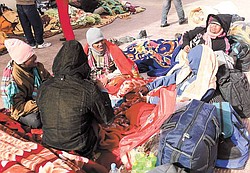
Stranded foreign workers, who fled Libya after the uprising against Libyan Leader Moammar Gadhafi, pass time playing cards by their baggage while waiting for Egyptian entry permission at the Egyptian terminal of the Egyptian Libyan border crossing of Salloum, Egypt Sunday, March 6, 2011. The U.S. and its allies should plan for a no-fly zone over Libya and consider bombing the country's airports and runways, but they should take no action unless there is an international agreement, the chairman of the Senate Foreign Relations Committee said Sunday. (AP Photo/Nasser Nasser)
Associated Press
BIN JAWWAD, Libya
Forces loyal to Moammar Gadhafi, some in helicopter gunships, pounded opposition fighters with artillery, rockets and gunfire Sunday, dramatically escalating their counteroffensive to halt the rebels’ rapid advance toward the capital.
They also battled to loosen the grip of rebels on two cities close to Tripoli. In at least one case, their tactics appeared to lead them into a trap.
Residents said pro-Gadhafi troops punched into the city of Misrata, 120 miles east of Tripoli, the capital, with mortars and tanks but were pushed out five hours later by rebel forces. The rebel commanders intentionally opened the way for government tanks to enter the city, then surrounded them and attacked with anti-aircraft guns and mortars, said Abdel Fatah al-Misrati, one of the rebels.
“Our spirits are high,” al-Misrati said. “The regime is struggling, and what is happening is a desperate attempt to survive and crush the opposition. But the rebels are in control of the city.”
As fighting across Libya grew more fierce, the international community appeared to be struggling to put military muscle behind its demands for Gadhafi to give up power.
A small British delegation sent to talk to the rebels headquartered in the main eastern city of Benghazi, meanwhile, was arrested by the rebels themselves, who said the group had entered the country without permission.
Sunday’s fighting appeared to signal the start of a new phase in the conflict, with Gadhafi’s regime unleashing its air power on the rebel force trying to oust the ruler of 41 years.
The uprising against Gadhafi, which began Feb. 15, is already longer and much bloodier than the relatively quick revolts that overthrew the longtime authoritarian leaders of neighboring Egypt and Tunisia.
Libya appears to be sliding toward a civil war that could drag out for weeks, or even months. Both sides seem to be relatively weak and poorly trained, though Gadhafi’s forces have the advantage in numbers and equipment.
In the United States, meanwhile, this country and its allies should plan for a no-fly zone over Libya and consider bombing the country’s airports and runways, but they should take no action unless there is an international agreement, the chairman of the Senate Foreign Relations Committee said Sunday,
Sen. John Kerry, D-Mass., and other lawmakers continued a drumbeat for military action in Libya, in the face of reluctance from the White House and U.S. defense officials, who argue that taking out Libya’s air defenses would be tantamount to going to war.
Hundreds if not thousands of people have died since Libya’s uprising began. More than 200,000 people have fled the country, most of them foreign workers.