 43
43

CSI: Union is on the case
 Photo
Photo
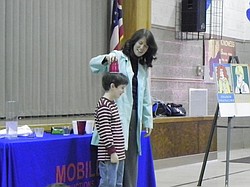
With the help of Carmen Dalesio (left) Day explained how casting slush works in crime scenes, by making “casts” of items too soft to move. After adding water to the slush mixture to start a chemical reaction, Day showed how quickly the mixture hardens by placing a cup of the slush upside down on Dalesio’s head with no mess.
 Photo
Photo
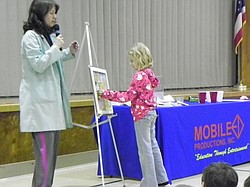
Kathleen Day (left) told the students of Union that solving a crime is a lot like solving a puzzle. Day called up Sophie LaLonde (right) to solve an easier puzzle before explaining the more complicated process of solving a crime.
 Photo
Photo
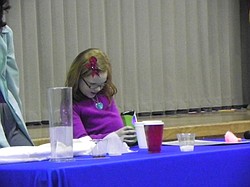
Kylie Duby was chosen to investigate fingerprints on a Styrofoam cup with a blacklight. The demonstration showed the students that everything a person touches leaves a trace.
 Photo
Photo
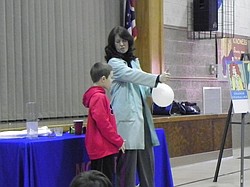
Day also explained how important fingerprints are to crime scene investigations. Day (right) placed Jeffrey McAuley’s(left) fingerprint on a balloon and then blew it up to show the print’s detail.
By SARAH FOOR
Kathleen Day, a representative with Mobile Ed Productions, offered Union Elementary students a classic whodunit scenario on Feb. 11. The mystery, called “The Great Cat Caper,” taught the students about the science of crime scene investigating and tools used to catch criminals.
Day began her assembly by telling the students about the importance of science in their curriculum.
“Do you like science?” she asked the school, and received a chorus of agreement. “That is great news! That means that you’re curious about the world around you. Curiosity makes life far more interesting.”
The students were then given the details of “The Great Cat Caper,” an imaginary crime where hundreds of cats were released from a local veterinary clinic. Simultaneously, Day revealed clues from the crime and explored scientific themes, receiving lots of help from Union students.
The crime-solving started with a discussion on the three fictional main suspects for the crime — a female veterinary assistant, a janitor and the veterinarian. Day asked the students who they thought perpetrated the crime.
“It wouldn’t be the girl because girls are so nice — so you’re not allowed to suspect her,” said Colton Diaz.
“I like your thought process, but we’ll need evidence to support your claim,” said Day.
Throughout the presentation, Day explored theories in physics, chemistry, and biology while gathering a wealth of evidence for the crime.
In the end, the perpetrator of the crime was the veterinarian. Although the character was clever in his crimes, the sleuths at Union used evidence and reasoning to catch the bad guy.
“Solving crimes uses lots of important skills,” said Day at the close of the show. “Patience and persistence can get you very far in finding bad guys, and in life, too.”