 43
43

Legislation limiting bargaining heads toward Senate vote
The Vindicator (Youngstown)
 Photo
Photo
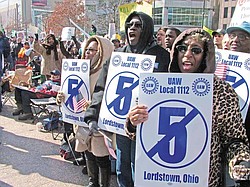
Frances Turnage, left, Marilyn Moore and Peggy Campbell were among about 200 United Auto Workers members from the General Motors Lordstown complex who traveled to Columbus on Tuesday to protest proposed changes to the state's collective-bargaining laws. Senate Bill 5 would limit bargaining for state and local public workers throughout Ohio.
SB 5 CHANGES
Senate Bill 5 amendments, as proposed by Republicans:
Reinstates collective bargaining for state employees Allows collective bargaining for wages, hours and employment terms but not for health-care benefits, pensions, privatization of services, work force numbers and other provisions.
Bans strikes by all public employees and establishes criminal penalties for those who do.
Establishes new procedures for workers and management to deal with disputed contract terms. The final step in the process would be review by the local legislative body for public hearings and an eventual decision.
Removes firefighters ranked as lieutenant or higher from collective bargaining units.
Establishes public-employee pay ranges plus guidelines for vacation and sick leave. Vacations would be capped at 7.7 hours per biweekly pay period after 19 years of service, a change from the current 9.2 hours after 24 years of service. Sick leave would be accrued at 10 hours per year.
Prohibits length of service as the sole factor used in determining layoff order.
Source: Senate Republicans
By Marc Kovac
COLUMBUS
Republicans in the Ohio Senate are poised to move on legislation overhauling the state’s collective-bargaining laws, with a floor vote coming as soon as today.
And Sen. Kevin Bacon, a Republican from the Columbus area and chairman of the Insurance, Commerce and Labor Committee, said he believes there are enough supporters in the chamber to approve Senate Bill 5.
“I don’t know that we’ll get a unanimous vote,” Bacon told reporters Tuesday. “But we do have enough to get it out of committee and off the floor.”
Bacon’s comments came after a committee hearing Tuesday where Republicans unveiled 90-plus pages of changes to SB 5, including allowing state workers to collectively bargain for wages. The original version would have prohibited collective bargaining for those employees.
The omnibus amendment also would ban strikes by all public employees. Violators would face fines and jail time.
Additionally, the new version of the bill would establish a new process for handling disputes between employees and employers. A final step would involve public hearings on the two sides’ last-best offers, with the governing legislative body deciding which side to accept.
And it sets public employee pay ranges and vacation and sick time guidelines.
In a released statement, Sen. Shannon Jones, a Republican from Springsboro and primary sponsor of the bill, said the changes address concerns brought up by 100 witnesses during 22 hours of public testimony.
“We’re staying focused on reducing the cost of government and making Ohio competitive, and the first place to start is with our own budgets,” she said. “This bill gives power back to the taxpayer and restores flexibility to the management of their hard-earned dollars.”
She added, “I look forward to passing these critical reforms so that we can get Ohio back on a path of fiscal stability, economic growth and job creation.”
Jones offered the omnibus amendment during Tuesday’s committee hearing, though members did not vote on whether to accept it. Instead, Bacon said he wanted the committee to have until this morning to review the proposed changes and ask questions.
Democratic opponents of the bill said deliberations on the legislation were moving too quickly.
Sen. Joe Schiavoni, D-33rd of Canfield, ranking member of the committee, said he did not have a copy of the amendments while they were being summarized during Tuesday’s hearing, so he could not comment on whether he would support the changes.
“We’re going to take a look at it overnight, and we’re going to have a meeting, and we’re going to try to get our questions together for tomorrow,” he said.
“And the questions are ... going to be asked so that people understand what’s in here. I mean, we’ll go through this thing all night if we have to.”
Senate Minority Leader Capri Cafaro, D-32nd of Liberty, agreed: “Something that is this significant, that is trying to reform a law that has been functioning for the last 27 years, to be pushed through in a matter of a handful of hearings... this is going through at breakneck pace.
“I don’t think that there is an opportunity to really vet it in the appropriate way.”
At least one Republican member of the committee isn’t supporting the bill in its current form.
“I don’t think that we have been sufficiently sensitive to the fact that many of these public employees with 20 or more years of service are not going to qualify for Social Security, are not going to get Social Security and are therefore inadequately protected by this bill against arbitrary layoff in order to deprive them of their public pension that they have staked their entire career towards earning,” said Sen. Bill Seitz, from Cincinnati.
Once the bill restricting collective bargaining makes its way out of the Ohio Senate, state Rep. Robert F. Hagan will be waiting for it in the House.
The bill should come to the Ohio House’s Commerce and Labor Committee next week.
Hagan of Youngstown, D-60th, is the only Mahoning Valley legislator on that committee.
Hagan, who opposes the bill, said he will carefully scrutinize the proposal during committee hearings.
Though Hagan said the bill is bad for the state and unions, he’s impressed by the turnout of thousands of protesters opposed to the proposal.
“I’ve never seen crowds as large as this in the 25 years I’ve been here,” he said Tuesday from the Statehouse in Columbus.
“It’s about time. I feel that people have finally realized they need to fight Republicans who are trying to destroy the middle class.”