 43
43

Man’s devices help quadriplegic gamers
ASSOCIATED PRESS
 Photo
Photo
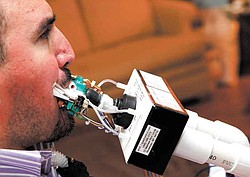
Ruben Rios who is a quadriplegic plays a video game using a special mouth controller in his home in Norwalk, Calif., Thursday, June 2, 2011. When Ruben Rios plays videos games he uses top and bottom lip controls, a cross bar mouth joystick and a number of holes and tubes he can puff or sip into to articulate actions in game. (AP Photo/Jae C. Hong)
Associated Press
HELENA, Mont.
For Ruben Rios to throw a touchdown, it takes a flick of his tongue. To break away from a tackle, he puffs into a tube.
Rios is a quadriplegic with no use of his body below his shoulders. For Rios to play video games like “Madden NFL 11” he uses a controller that combines lip controls, puff and sip tubes and a head-operated joystick.
That mouth controller is an innovation from Ken Yankelevitz, a Montana engineer whose hobby is hand-making unique controllers to give quadriplegics access to video games usually requiring two hands.
But with the retired Bozeman engineer’s 70th birthday approaching, disabled gamers say they fear there will be no one to replace Yankelevitz, who has sustained quadriplegic game controllers for 30 years almost entirely by himself. The retired aerospace engineer hand makes the controllers with custom parts in his Montana workshop, offering them at a price just enough to cover parts.
Gamers and gaming advocates say the Yankelevitz controller’s functionality and price is unrivaled for quadriplegics.
Yankelevitz began his work on mouth-operated video game controllers in 1981 for the Atari game console to give quadriplegic people a chance to engage with one of the few activities open to them. The design was simple on the early models; users only needed to be able to push a few buttons and move a joystick through their controllers.
Over time Yankelevitz adapted the designs to more complex consoles including the XBox and PlayStation platforms. He has no formal relationship with any of the companies, saying they aren’t interested because there isn’t a sufficient market.
“If the bottom line is profit, there’s no way to make a profit on these,” Yankelevitz said.
Yankelevitz said larger companies and game manufacturers have shown no interest in producing the controllers because the market is so small. He’s sold just over 800 of the devices through 30 years. Factory construction of the controller would be cost prohibitive, over $1,000 each, he said.
Other products don’t offer near the same functionality, and they come at a much higher price. There looks to be no comparable substitute available in the near future.
“If Ken [Yankelevitz] stops making these controllers we’re going to be pretty much left out to dry,” Rios said.