 43
43

Crash spotlights driver fatigue
ASSOCIATED PRESS
 Photo
Photo
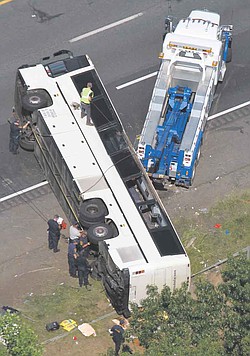
FILE In this May 31, 2011 file photo rescue personnel work on bus that overturned in Bowling Green, Va. Prosecutors have charged Cheung, 37, of Flushing, N.Y., with four counts of involuntary manslaughter. But sleep scientists, safety advocates and labor leaders say the roots of the accident lie with an industry whose economic model often results in drivers on the road with too little rest and at hours when their bodies naturally crave sleep. (AP Photo/Steve Helber, File)
Associated Press
BOWLING GREEN, Va.
Energy drinks, coffee and, even talking on his cellphone weren’t enough to keep bus driver Kin Yiu Cheung awake after a night on the road.
About an hour before dawn, nearly seven hours into his shift, Cheung dozed off as his bus carrying 59 passengers barreled northward on Interstate 95 in Virginia on May 31, according to court documents.
The bus veered off the highway. When Cheung tried to swerve back onto the road, the bus hit an embankment and overturned, authorities say. Four passengers were killed and dozens more injured. Attorneys for Cheung, who remains in jail without bond, have called the wreck a “tragic accident.”
Prosecutors have charged Cheung, 37, of Flushing, N.Y., with four counts of involuntary manslaughter. But sleep scientists, safety advocates and labor leaders say the roots of the accident lie with an industry whose economic model often results in drivers on the road with too little rest and at hours when their bodies naturally crave sleep.
“The consequence is an entire industry populated by people not getting enough sleep,” said Larry Hanley, president of the Amalgamated Transit Union, which represents drivers at Greyhound and other companies.
Studies show that between 13 percent and 31 percent of commercial-vehicle crashes are due to driver fatigue, according to the National Transportation Safety Board.
Recent deadly crashes involving motor coaches — large buses that travel between cities, such as the vehicle Cheung was driving — have heightened concern about driver fatigue. In March, a bus returning passengers to New York’s Chinatown after a night of gambling ran off an elevated highway and hit a utility pole, shearing off its roof. Fifteen passengers were killed and many more injured. The driver has said he was awake and alert, but passengers told police the bus was swerving. A lawsuit filed by one passenger claims the driver was asleep.
The Federal Motor Carrier Safety Administration, which oversees the nation’s estimated 4,000 passenger-bus companies, had flagged the bus company in the New York crash, World Wide Travel, for possible extra scrutiny due to violations involving driver fatigue.
Sky Express Inc. of Charlotte, N.C., which employed Cheung to drive from North Carolina to New York, had been cited for 46 violations involving driver fatigue rules over two years, ranking it in the bottom 14 percent of motor carriers. Passengers on the bus that crashed overheard Cheung complaining in a cellphone call that he was tired and that he didn’t have much turn-around time between trips, according to a court affidavit.
Federal officials were in the process of shutting down the company at the time of the crash. A timeline released by the Department of Transportation showed Sky Express would have stopped operations the weekend before the May 31 crash if regulators hadn’t extended their review an extra 10 days.
Bus-industry officials say motor coaches have a good safety record. The popularity of motor-coach travel has soared over the past decade, in part because it’s relatively inexpensive. The industry transports an estimated 750 million passengers annually in the U.S., roughly equivalent to the domestic airline industry — yet only about 20 passengers a year are killed in accidents.
Pete Pantuso, president of the American Bus Association, said fatalities primarily are the fault of a handful of small operators who ignore safety regulations to cut costs. When the government orders them to shut down, they reopen under a new name or in a new location. The problem is so common they are known in the industry as reincarnated or chameleon carriers.
That’s what federal officials say Sky Express did after the crash. Regulators ordered the company to shut down hours after the accident. But Sky Express continued to operate using two other names, 108 Tours and 108 Bus. The department issued a cease and desist order.