 43
43

Trip to China was educational
 Photo
Photo
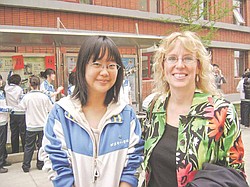
Louise Mason spent some time shopping with Coocan, a student at Bejing National Day School, who will study at Yale University in New Haven, Conn.
By LINDA M. LINONIS
GIRARD
Louise Mason stood out in more than one way when she visited China through the China Exchange Initiative, which arranges for American and Chinese educators to spend time in one another’s countries.
The physical features of the blonde, blue-eyed, 5-foot-71/2-inch principal at Girard Junior High School set her apart from the dark-haired, dark-eyed Chinese. Many wanted to have their photos taken with her because she looked so different, she said.
But beyond that, Mason said the Chinese educators were impressed with what she had attained as a woman — an administrative position. “Most administrators [there] are men. Lower-ranking administrators are women, and most teachers are women,” she said.
Mason hosted Deng Zhongqing, a Chinese educator she called her “cultural counterpart” in December 2010. The principal of Yingcheng Experimental School in Yingcheng visited GHS and brought gifts including a friendship scroll. Deng monitored Girard classes, observing how students and teachers interacted. In turn, Deng hosted Mason while she was in his country. They used a computer to translate and communicate and also had an interpreter.
Mason’s trip took place April 6-24, and she traveled with 12 other educators from Ohio who were part of a group of 20 American educators. They flew from Pittsburgh to Chicago, then to Bejing, a trip of some 12 hours, then another 11/2 hours to Xian. “It seemed like it happened all in one day ... when we arrived it was the same time we left America only a day ahead,” she said.
In Xian, the American educators visited three types of schools — farming, migratory and city. “Farming schools are for children of peasants and out in the countryside, and students at migrant schools are those whose parents are migrant workers,” she said. “City schools are all ranked, and students test to get into the top-ranked schools. Most are boarding situations.”
Mason said mandatory education goes up to the ninth grade in China; completing the 10th, 11th and 12th grades is optional. “But education is so valued in China, and there are high expectations for students,” she said. “There is a deep respect for education, discipline and work ethic.”
Mason said it isn’t unusual for some 40 to 50 students to be in a class.
The first part of the trip she spent with the other Americans; the last part, she was with Deng in Yingcheng. At the number one middle school there in the province of Hubei, there were 72 students in a class. “The students are sitting so close together — five deep and side by side. But there’s no fooling around or talking,” she said. “No one speaks out of turn.”
Mason said she was impressed by the courtesy and respect shown. The students bow to greet the teacher, who returns the gesture.
She described the Chinese classroom as lecture-oriented. On his visit, Deng commented to Mason that American education was “more hands-on,” and that’s what he wanted to learn to accomplish at his school. “We encourage creative thinking and problem-solving,” Mason said. American schools teach, for example, science, math and computer technology, then challenge students to apply the facts and solve problems through various projects.
But, she noted, Americans had to remind themselves that China is under a Communist regime, so independent thinking isn’t something that is encouraged.
Mason said Chinese students have facts and figures down pat but have a hard time applying them to solve real-world problems through creative thinking. “Critical or creative thinking isn’t encouraged, so it’s lacking,” she said.
Students spend from 7 a.m. to noon and 2 to 5 p.m. in the classroom on weekdays with a two-hour lunch break. They also do self-study of math and science on Saturdays and Sundays.
At Deng’s experimental school, with 3,400 students, the students stay in one classroom, and teachers move from room to room. Classes are 45 minutes long with 10 minutes between.
Mason said Chinese school days include exercises including stretches, knee bends and lunges.
She said though most American students realize the important of education, they do not take it seriously enough. She said Deng told her he thought American students had “too much freedom.” Mason said about 85 percent of Chinese students complete the ninth grade.
Mason communicated with Girard students via the Internet and posted photos on the school website, www.girardcityschools.org.