 43
43

Jim Tressel’s resignation is just the first domino to fall at Ohio State
ASSOCIATED PRESS
 Photo
Photo
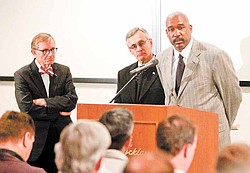
FILE- In this March 8, 2011 file photo, Ohio State athletic director Gene Smith, right, takes questions during a news conference with university president E. Gordon Gee, left, and football coach Jim Tressel, center, in Columbus, Ohio. Smith, unable to talk about the ongoing NCAA investigation, does touch upon some fine points of the suspensions of football coach Jim Tressel and five of his players. (AP Photo/Terry Gilliam, File)
- Tressel's Resignation
-
- Photo gallery: Jim Tressel at YSU
- Scandal may hurt OSU’s recruiting
- Maurice Clarett speaks
- Valley VIPs come to Tressel’s defense
- Pryor ends his silence with 97-second apology
- Luke Fickell takes over as Ohio State interim head coach
- Tressel skips rules meeting
- Pryor hires agent, prepares for draft
- Expert: Ohio State scandal in ‘leaky faucet phase’
Jim Tressel’s resignation is just the first domino to fall at Ohio State. Other college coaches say there’s lessons to be learned by the scandal.
Associated Press
In the wake of Jim Tressel’s resignation, attention is now focusing on the job security of Ohio State president Gordon Gee and athletic director Gene Smith.
Both Gee and Smith offered unwavering, and in the case of Gee, gushing-to-the-point-of-embarrassing support for Tressel at a March 8 news conference.
Since then, it’s become clearer that the NCAA may take a hard line on the university’s transgressions, and Tressel’s resignation was likely the first attempt to minimize damage to the university.
But the university is already facing new allegations about its football program, including questions about cars driven by quarterback Terrelle Pryor and a growing number of alleged violations involving players’ sales of OSU memorabilia. Ohio State faces an Aug. 12 date with the NCAA’s committee on infractions, which could lead to vacated games and seasons, a bowl ban and recruiting limitations.
Ohio State trustees referred calls to Gee’s office, and both Gee and Smith declined comment on Tuesday.
Both were thought to be distancing themselves from Tressel — despite their earlier praise of the coach’s integrity and honesty — in the weeks leading up to Monday’s resignation. Likewise, both played roles in Tressel’s departure.
Smith met with Tressel on Sunday night and again on Monday, making it clear that the coach needed to resign. Gee also had a hand in the situation. He selected a special, eight-person committee of administrators and members of the university’s board of trustees to review and analyze all aspects of the issues surrounding the beleaguered football program.
In a note to the board of trustees notifying them of Tressel’s resignation, Gee said he had been “actively reviewing” the matter.
Even if the NCAA — which continues to investigate Ohio State’s athletic department — were to find nothing else wrong with the program, there has been a rising tide of dissatisfaction with both Smith and Gee by alumni, fans and donors.
Gee didn’t help his cause with a joke he made at a March 8 news conference when asked by a reporter if he had considered firing Tressel.
“No, are you kidding?” Gee said. “Let me just be very clear: I’m just hopeful the coach doesn’t dismiss me.”
In a profession that provides little in the way of job security, Tressel was about as comfortable as a college football coach could get.
He won 83 percent of his games in 10 seasons with Ohio State. He went 9-1 against Michigan, won seven Big Ten titles and a national championship.
But when Tresel committed the cardinal sin of college sports, covering up an NCAA violation in his program, none of his success on the field could save him.
While NCAA president Mark Emmert has talked tough in recent months about cracking down on rule-breakers with penalties severe enough to deter future wrongdoers, maybe Tressel’s departure will help send that message.
“It’s a tough situation for Jim and his family, but also I think if we’re going to find anything good in this it can be a wake-up call for [other coaches],” said former Baylor coach Grant Teaff, the president of the American Football Coaches Association.
“There are a myriad of rules. There’s no excuse for any of us missing those rules. It’s not an easy task, but it never has been. It’s always been a challenge but probably rightly so, because it’s an important job.”
When a guy like Tressel goes down, other coaches pay particular attention.
“I know all this stuff that’s happening at Ohio State, every other coach out there, if ever presented that situation, I am sure they will think about how to handle it,” Tennessee coach Derek Dooley said.
Or as Arkansas coach Bobby Petrino said: “There’s no question there’s lessons to be learned.”
The main lesson being: Don’t think for a second you are A) above the rules or B) won’t get caught breaking them. Oh, and C) no matter how noble your intentions might be, if you break the rules it could cost you your job.
Teaff said following the rules and doing what’s best for a player are not always the same thing.
“It may appear you’re not acting in the best interest of your student-athletes, but the rules may overshadow that particular feeling you may have,” Teaff said.
“There’s definitely pressure to win,” Petrino said, “we’re all in it to win, we’re all in it to live by the rules and we all know that when one violation happens or two violations, I can walk into our athletic director’s office and our director of compliance and say, ‘Hey, look, we made a mistake here.’ And you self-report it and you live by what happens with that.”