 43
43

Tressel drops the ball, loses what was the job of a lifetime
ASSOCIATED PRESS
 Photo
Photo
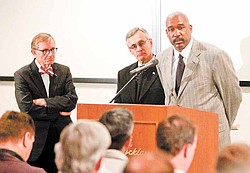
FILE- In this March 8, 2011 file photo, Ohio State athletic director Gene Smith, right, takes questions during a news conference with university president E. Gordon Gee, left, and football coach Jim Tressel, center, in Columbus, Ohio. Smith, unable to talk about the ongoing NCAA investigation, does touch upon some fine points of the suspensions of football coach Jim Tressel and five of his players. (AP Photo/Terry Gilliam, File)
- Tressel's Resignation
-
- Photo gallery: Jim Tressel at YSU
- Scandal may hurt OSU’s recruiting
- Maurice Clarett speaks
- Valley VIPs come to Tressel’s defense
- Pryor ends his silence with 97-second apology
- Luke Fickell takes over as Ohio State interim head coach
- Tressel skips rules meeting
- Pryor hires agent, prepares for draft
- Expert: Ohio State scandal in ‘leaky faucet phase’
About 15 years ago, comedian Jay Leno was sitting across from a Hollywood star who had be caught in an compromising position and asked a six-word question that captured the absurdity of the situation: “What the hell were you thinking?”
That same question could be asked of former Ohio State University football coach Jim Tressel of his state of mind back in April 2010 when a former OSU player sent him an email with apparently the best of intentions alerting Tressel to the fact that some of his players had been trading Ohio State memorabilia for tattoos. As if that weren’t bad enough, the tattoo parlor owner was under investigation for drug dealing.
What, one must wonder today, was Tressel thinking? How could he have imagined that this OSU connection to a federal drug investigation was going to stay under wraps? How could as brilliant a football tactician as Tressel not done the calculus that showed coming clean was not only the right thing to do, but the smart thing to do? How could someone as familiar with the odds of success vs. failure in calling plays on the football field not have seen that pretending no wrong had been done not only had little chance of success, but when the lid inevitably blew off, the damage done was going to be greater?
There are a lot of questions in that paragraph, and the only one who could begin to answer them is Jim Tressel. And so far, nothing he has said has come even close to providing an explanation.
But we learned Monday the consequences of silence and of Tressel’s signing an NCAA statement last fall in which he falsely attested to the eligibility of his players. Tressel, 58, has lost his $3.5 million a year job, and has made it virtually impossible for any other college program to hire him, at least in the near future.
It is a sad cap on an extraordinary career, one that put the Youngstown State University Penguins football program on the national map and restored gridiron glory and dominance over Michigan to the Buckeyes.
History will sort out whether Tressel allowed himself to be blissfully ignorant of misbehavior on his football squads or whether he was an active enabler. There are more than enough people on both sides of that argument who claim to know the answer. But they are at best making educated guesses.
Hometown passion
In many ways, Youngstown is still a small town, and in this town a lot of people came to know Jim Tressel, even if through no more than a handshake at a banquet or along the route of a victory parade. And so it is difficult to be dispassionate. And there still seems to be more anecdotal evidence that Tressel was a man who worked to model young people into successful adults, rather than someone willing to win at any cost.
Entering the ring of public opinion to do battle over the nature of Jim Tressel are those eager to bring down a man who they always suspected was too good to be true and those unwilling to acknowledge even obvious flaws. The truth lies somewhere between them.
What we do know is that while there may be rule bending in NCAA athletics, the excuse that “everybody does it” won’t fly. Even as bad as it now looks for the Buckeyes, clearly everybody on the squad wasn’t selling memorabilia and hitting up rich boosters for cars or money. And on some squads, nobody does. To the extent that what appears to be an alarmingly high number of players were, the OSU program (and maybe some above and below Tressel) will be paying the price.
Knowing that coaching OSU had long been Tressel’s dream job — he passed up other big-time offers while coaching at YSU — it’s clear that whatever Tressel was or wasn’t thinking last April, he’s now painfully aware that he made the wrong choice.