 43
43

Solar panels provide power at Warren's JFS building
 Photo
Photo
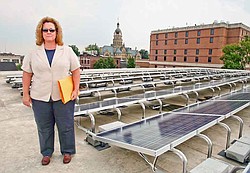
The roof of the Trumbull County Department of Job and Family Services building on North Park Avenue features 234 solar panels that gather the energy from the sun and turn it into electricity. Trish Nuskievicz, assistant Trumbull County planning director, gave members of the Eastgate Regional Council of Governments Environmental Planning Advisory Committee a tour of the installation Thursday.
By Ed Runyan
WARREN
When you stand on the roof of the Trumbull County Department of Job and Family Services building on North Park Avenue, it feels as if you’re standing on a swimming pool liner.
On the liner are 234 solar panels that gather the energy from the sun and turn it into electricity.
The panels, made in Memphis by Sharp Electronics, are not bolted down, only resting on pads. They will remain there for decades without damaging the membrane roof or needing any maintenance, said Trish Nuskievicz, assistant Trumbull County planning director.
Concrete blocks give weight to the solar panels, preventing them from lifting off in the wind. The system is able to withstand winds of 90 mph, Nuskievicz said.
On Thursday, Nuskievicz gave members of the Eastgate Regional Council of Governments Environmental Planning Advisory Committee a tour of the installation.
The Job and Family Services building, just north of Courthouse Square, was chosen because it had a new roof after being renovated several years ago.
Another building that might provide a good opportunity for a solar-collection system is the One-Stop building under consideration by the city of Warren, Nuskievicz said.
City council will continue discussion in September on whether to construct such a building, probably downtown, to consolidate city offices into a more energy-efficient and user-friendly arrangement.
“It takes a good roof,” Nuskievicz said of rooftop solar projects.
Trumbull County’s project, which was made possible by a $270,000 federal stimulus grant, was installed and producing electricity by June 1.
Because the county paid none of the project’s costs, the county has reaped the benefits of the entire $3,274 in energy savings that have been generated so far, Nuskievicz said.
The solar panels are generating around $1,800 worth of electricity savings per month during the summer — about a third of the building’s total electricity use.
It is unknown how much they will generate during other times of the year, Nuskievicz said.
“This is saving us taxpayers on utility bills, and as utility costs continue to increase, the savings will increase as well,” said Eastgate EPAC member James Pirko.
“I’ve been advocating for renewable energy since the 1970s, and I’m just glad to see it happen in my lifetime,” Pirko said.
Tom Angelo, director of Warren’s wastewater plant, also told EPAC about the $500,000 federal-stimulus project carried out at the plant last October to generate electricity by using the force of the 13 millions of wastewater flowing each day out of the plant on its way to the Mahoning River.
Angelo described the project as a micro-hydro power plant, “like Hoover Dam, only smaller.”
The flow of water at the plant changes depending on the time of day, but “as long as water is running, it’s generating electricity, and as long as people are flushing their toilets, the water is running,” Angelo said.
Angelo didn’t give a dollar amount of savings resulting from the generator but said it will pay for itself in 30 to 70 years.
“The point of this is, it’s a demonstration project,” Angelo said, explaining that Warren will not have credibility for its fledgling Tech Belt Energy Innovation Center downtown “if you’re not willing to invest in [energy innovation] yourself.”