 43
43

Fast-food chains trying fresh, new looks
 Photo
Photo
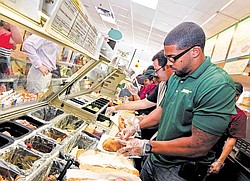
Houston football star Arian Foster prepares BBQ Pulled Pork sandwiches for fans at a Subway restaurant at the Subway All-Star BBQ in Los Angeles. Subway is one of several fast-food restaurants updating its look.
By Tracy Turner
Columbus Dispatch
COLUMBUS
It seems that burger joints don’t want to look like burger joints anymore.
In newly designed restaurants being rolled out by Wendy’s, McDonald’s and others, flat-screen TVs, art-deco furniture, ambient lighting, hardwood floors and muted colors are replacing industrial plastic tables, steel swivel chairs and linoleum flooring.
As more customers gravitate to fast-casual restaurants such as Panera, Chipotle and Starbucks — all of which have modern designs that generally are heavy on natural-look materials — other fast-food chains are following suit.
The move is part of a growing trend to refocus on adult diners who grew up on a restaurant chain’s food but don’t want to settle down to dinner in a setting designed for kids.
Dublin, Ohio-based hamburger chain Wendy’s is testing four new store designs, one of which also includes comfy chairs with ottomans, coffee tables, wood-grained tables and pullout chairs, fresh flowers, glass walls and a fireplace.
The new stores are scheduled to reopen late this month. This version of its new design options — all four are being tested but the company won’t say precisely where — could ultimately be the one used on all of its new and remodeled restaurants, spokesman Denny Lynch said.
The tests are part of Wendy’s plan to completely redesign its restaurants and the company itself, he said.
Wendy’s is only the latest fast-food chain to sink some money and thought into its dining environment.
McDonald’s plans to spend more than $1 billion to remodel 14,000 of its restaurants by 2015 to include a more-modern design, with new seating, free Wi-Fi and flat-panel TVs.
Burger King is remodeling its locations to include a more-contemporary design with sleek furniture, also with more ambient lighting, free Wi-Fi and flat-screen TVs.
Even Subway, which doesn’t sell burgers but is the country’s largest fast-food chain based on number of stores, is testing its Subway Cafe concept in some of its Virginia locations. Those have leather armchairs, brick or wood-paneled walls and a fireplace.
Competition from fast- casual chains such as Chipotle and Panera is one reason that fast-food companies are undergoing such extensive redesign efforts, said Ron Paul, president of Technomic, a Chicago-based restaurant industry consultancy.
Chipotle and Panera offer a better decor, which gives consumers the perception of higher-quality food, he said.
Fast-food chains “are moving away from the plastic, fast-food seating because [the] competition is forcing them to rethink what they are doing,’ Paul said. “If they want to compete, they have to upgrade their environment. And the bar is being raised even higher now.”
This is taking place as the outlook for restaurants for the year is improving, said Bonnie Riggs, a restaurant analyst with NPD Group, a market-research company.
Dinner visits to fast-food chain restaurants increased 2 percent in the first quarter of 2011, NPD said. Quick-service restaurants, which represent 78 percent of total industry traffic, drove the growth at dinner, while visits at midscale and casual-dining chains — think Applebee’s — remained weak.