 43
43

Mahoning Valley struggles to create clean jobs
 Photo
Photo
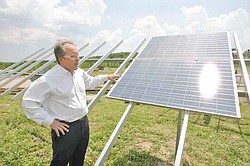
Bernie Petro, director of engineering at Northern States Metals Co., Youngstown, shows how the flex racks his company makes can accommodate many types of solar panels. The company, which originally produced aluminum extrusions, has adapted to create green jobs in the Mahoning Valley.
The Vindicator ( Youngstown)
Photo
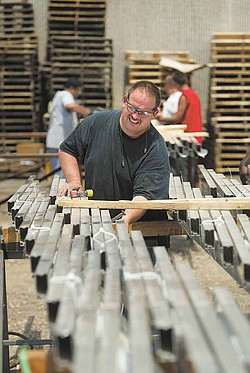
John Cheeks of Niles prepares a load of solar flex rack frames for shipping at Northern States Metals Co., located on the Youngstown’s West Side.
By Karl Henkel
YOUNGSTOWN
The Mahoning Valley may be regaining jobs unlike any other region in the nation.
But when it comes to green jobs, it’s still behind the curve.
The Brookings Institution, which three weeks ago reported surprisingly strong economic growth in the Valley following the trough of the recession, today released a report detailing the region’s struggles in creating clean — or “green” — jobs.
The region ranks 90th among the top 100 metropolitan areas in the number of clean-economy jobs. A total of 1.3 percent, or 2,977 of the Valley’s jobs, are clean.
The top 100 metro areas represent 75 percent of the nation’s total population, according to Brookings.
Ohio’s economy is made up of 2 percent, or 105,306 clean jobs, sixth-best among the 50 states and District of Columbia.
Ohio scored high, but in relation to the rest of the world, the U.S. still lacks substantial green-job growth.
The nationwide clean-economy sector employs 2.7 million. It’s something Brookings officials said has been a result of poor spending.
“When it comes to ... financing, where a lot of the risk takes place, we see that large banks are really sitting on the sidelines,” said Jonathan Rothwell, a senior research analyst for Brookings. “They’re deciding that these technologies aren’t proven enough.”
The technologies Rothwell spoke of are wind turbines — installed in Lordstown and at Western Reserve schools — and solar energy (a company like Northern States Metals in Youngstown), which are in the minority when it comes to green-job prowess.
The technology has caught on in countries like China, but that hasn’t been the case in the U.S.
“All of these things require the public’s support,” Rothwell said. “And the public right now is probably a little bit skeptical and a little bit bitter because of the lingering effects of the recession.”
The news isn’t completely gloomy, however.
The Valley’s clean-job sector has grown by 785 jobs since 2003, a 4.5-percent increase, which places it 49th among metros.
The annual wage ($34,923) is roughly $3,000 more than the average wage of all jobs in the region.
According to the report, the Valley’s largest green-job industries are waste management and treatment (1,224 jobs), public mass transit (557), recycling and reuse (442), professional environmental services (215) and energy-saving building materials (185).
Heating, ventilation and air conditioning, and building control systems (46 jobs, up from 10), air and water purification systems (18, up from 8) and organic food and farming (58, up from 34) were industries with the largest percentage increase from 2003 to 2010.
Another report, from the Union of Concerned Scientists, says that if Ohio is able to produce 30 percent of its energy supply by 2030, it will create 14,000 clean jobs by 2030 and pump $2.5 billion in new capital investment into the economy.
“Ohio has a tremendous opportunity by taking advantage of its natural resources to generate a lot of economic development in the states,” said Steve Frenkel, director of the Union of Concerned Scientists’ Midwest office.
Ohio’s current target goal is 12.5 percent by 2025.
“There’s a lot of money being left on the table,” Frenkel added. “The benefits [more money and jobs] far outweigh the costs. We’re not in the position to let those economic opportunities pass us by.”