 43
43

A game even US could love
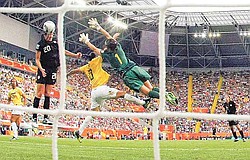
ASSOCIATED PRESS
 Photo
Photo
United States' Abby Wambach scores her side's 2nd goal during the quarterfinal match between Brazil and the United States at the Women’s Soccer World Cup in Dresden, Germany, Sunday, July 10, 2011. (AP Photo/Marcio Jose Sanchez)
See also: Cup classic: U.S. women stun Brazil
If Americans don’t fall in love with soccer after this, well, maybe they never will.
Yes, the epic quarterfinal win by the U.S. women over Brazil featured nearly everything their countrymen hate about the “beautiful game.”
They faced off against a team with better individual skills, plus an imagination and intuition about how to play that develops only over decades. They were handcuffed by lousy calls — with no chance of appeal — then mocked by dives and fake injuries cynically designed to steal their momentum and the little time that remained on the clock.
To top it off, after hard work and a last-gasp equalizer erased all that, their fortunes still hinged on those notoriously fickle penalty kicks.
But oh, that ending.
“That is a perfect example of what this country is about, what the history of this team has always been,” said Abby Wambach. “We never give up.”
As fate would have it, the win Sunday came a dozen years to the day of the previously most famous moment in U.S. soccer history, men or women, when Brandi Chastain put her penalty kick past China’s Gao Hong to win the 1999 Women’s World Cup and then stripped down to her sports bra. But that moment really said more about a paradigm shift in the culture of all sports in America than it did about the culture of soccer here.
Empowered by Title IX, the women on that team had grown up as girls determined to claim their share of the ball fields and resources that were always available to boys. And with opportunities and support for female athletes advancing faster here than anywhere else, plus a talented and photogenic superstar in Mia Hamm, the U.S. women were the class of the field when international play began in earnest in 1991.
They’ve managed to keep their place near the top of the game, coming into this cup ranked No. 1. But the small advantages they enjoyed over a handful of rivals are gone, and the even larger ones they held over the rest of the world are drying up fast. The simple truth is that even the best U.S. players, women and men, still don’t know how to play what we stubbornly insist on calling soccer and what everyone else has called football for more than 150 years.
Here, the world game is still an afterthought. The U.S. women, at least, have benefited from having access to the best athletes a rich nation of almost 300 million can produce, something that’s never been true for the men.
Even so, whatever breakthroughs U.S. soccer teams achieved over the last few decades have been almost entirely the result of a supreme effort by a dedicated corps of players who refused to be daunted by the odds. So it was one more time Sunday, by a women’s squad that was forced to play short-handed for all but a few minutes of the final hour and never gave up.