 43
43

Jobs data show weakest recovery since ’48
ASSOCIATED PRESS
 Photo
Photo
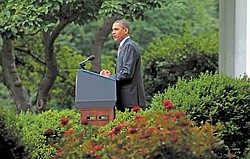
President Barack Obama delivers a statement on the monthly jobs report Friday in the Rose Garden of the White House in Washington.
Associated Press
WASHINGTON
The job market is defying history.
A dismal June employment report shows that employers are adding nowhere near as many jobs as they normally do this long after a recession has ended.
Unemployment has climbed for three-straight months and is now at 9.2 percent. There’s no precedent, in data going back to 1948, for such a high rate two years into what economists say is a recovery.
The economy added just 18,000 jobs in June. That’s a fraction of the 90,000 jobs economists had expected and a sliver of the 300,000 jobs needed each month to shrink unemployment significantly.
The excruciatingly slow growth is confounding economists, spooking consumers and dismaying job seekers. Friday’s report forced analysts to re-examine their assumption that the economy would strengthen in the second half of 2011.
They had expected improvement in June after a bleak jobs report for May. They figured that hiring in May had been artificially weakened by temporary factors — a run-up in gasoline prices to $4 a gallon and factory disruptions caused by Japan’s earthquake and nuclear crisis.
But the June numbers were even worse than May’s, even though gasoline prices are falling and factories revving up again.
“This is a remarkable, across-the-board backslide,” says economist Heidi Shierholz of the Economic Policy Institute.
Sometimes disappointing economic reports look better on closer inspection. This one gets uglier.
Workers’ hourly pay fell in June. They worked fewer hours. And 16.2 percent of those who wanted to work were either unemployed, forced to settle for part-time jobs or had given up looking for work. That figure was up from 15.8 percent in May.
One problem is that after slashing jobs during the Great Recession, employers still are reluctant to replace them. They’ve learned to squeeze more work and revenue out of reduced staffs. Productivity and corporate profits have soared. But companies don’t want to add workers until they’re confident that consumers are spending enough to support higher sales.
Other factors are restraining hiring, too. More-sophisticated software lets managers scrutinize changes in their businesses minute-by-minute. They can postpone hiring until they’re certain they need more workers.
Employers have good reason to wait, says economist Ken Mayland at ClearView Economics. A political standoff over the federal debt limit threatens to send the U.S. government into default next month. That would send interest rates soaring and might tip the economy back into recession.
Even if President Barack Obama and congressional Republicans agree to raise the borrowing limit, the deal likely will require deep cuts in government spending and possibly tax increases. Combined, those steps could slow the economy further.