 43
43

Mill Creek rain garden teaches how to help environment
 Photo
Photo
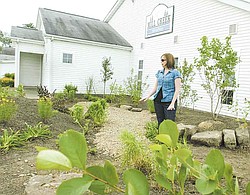
Kirsten Peetz, Mill Creek MetroParks environmental-land manager, talks about the new rain garden installed at the MetroParks Farm in Canfield. The garden, paid for by a grant, will absorb rainwater runoff and act as an educational tool.
 Photo
Photo
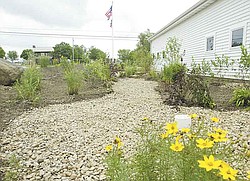
A new rain garden installed at the Mill Creek MetroParks Farm in Canfield was funded through a $10,850 surface-water improvement grant from the Ohio Environmental Protection Agency. MetroParks received the grant in May 2010.
By Elise Franco
efranco@vindy.com
Canfield
It would be easy, on the way into McMahon Hall at the Mill Creek MetroParks Farm, to breeze past the new rain garden.
A visitor might think it’s just fancy landscaping.
But MetroParks officials want to make sure that very thing doesn’t happen.
Construction on the 2,300-square-foot garden, at the entrance of McMahon, began in late June and is now complete. An interpretive sign will catch the eye of visitors and explain how the garden works.
“We built it as a demonstration so that people can understand what a rain garden is,” said Kirsten Peetz, MetroParks environmental-land manager. “We get a lot of visitors here at the MetroParks Farm.The exposure is a good way to introduce the concept so people can see it working.”
The garden was funded through a $10,850 surface water improvement grant from the Ohio Environmental Protection Agency. The MetroParks received the grant in May 2010, she said.
Peetz said the rooftop gutters were disconnected from the area around the garden, allowing rainwater to run off the roof and absorb into the soil.
Depending on the amount of rain that falls, Peetz said all of the water should absorb into the soil within 24 to 48 hours.
She said this is not only one way for people to alleviate flooding, but it’s better for the environment.
“In general, when rainwater goes directly into the stormwater drain, the runoff is directed into creeks and wetlands,” she said. “Any contaminates that are in that are dumped directly into those bodies of water.”
Justin Rogers, MetroParks landscape architect, designed the rain garden with the intent of making it functional, as well as aesthetically appealing.
Rogers said the garden includes plants native to Ohio, as well as visual features such as sandstone, gravel and mulch.
“That gives it interest, plus all of those items can be found locally,” he said. “We wanted to give people something that is attainable within their own yards.”
Rogers said a homeowner interested in installing a rain garden at home likely would spend between $1,000 and $1,200. He said it would need to be only about one-third of the size of the MetroParks’ garden.
“You would need to figure out the immediate watershed area, then it’s the same process in terms of feeding the water through the roof,” he said.
In order to ensure the water is absorbed properly, Rogers said some ground excavation is necessary.
“We excavated a lot of clay material and added in a lot of organic materials such as sand, compost and topsoil,” he said.
Peetz said when the MetroParks applied for the grant in February 2010, it was one of 172 applicants in Ohio and one of only 32 awarded the funding.
“The money for things like this has to go somewhere,” she said. “We want to them come to Mahoning County to benefit our parks and our residents.”