 43
43

Homeowner fights get ugly
ASSOCIATED PRESS
 Photo
Photo
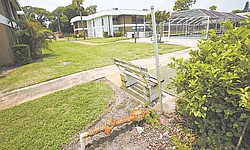
In this June 15, 2011 photo, an empty park bench and rusting pipe sit near the swimming pool at the Inlet House, in Fort Pierce, Fla. The complex was an affordable place that the 55-and-older set aspired to. But now the Homeowner's association has levied a $6,000 assessment on every homeowner and then foreclosed on seniors who did not owe the bank a dime but could not afford the association bill. (AP Photo/J Pat Carter)
Associated Press
The Inlet House condo complex in Fort Pierce, Fla., was once the kind of place the 55-and-older set aspired to. It was affordable. The pool and clubhouse were tidy, the lawns freshly snipped. Residents, push-carts in tow, walked to the beach, the bank, the beauty parlor, the cinema and the supermarket. In post-crash America, this was a dreamy little spot. Especially on a fixed income.
But that was Inlet House before the rats started chewing through the toilet seats in vacant units and sewage started seeping from the ceiling. Before condos that were worth $79,000 four years ago sold for as little as $3,000. And before the homeowners’ association levied $6,000 assessments on everyone — and then foreclosed on seniors who couldn’t pay the association bill, even if they didn’t owe the bank a dime.
Normally, it’s the bankers who go after delinquent homeowners. But in communities governed by the mighty homeowners’ association, as the sour economy leaves more people unable to pay their fees, it’s neighbor versus neighbor.
“What the board is doing is trying to foreclose on people to force people out the door,” says Mike Silvestri, 75, who stopped paying his dues at Inlet House in protest over what he considers unnecessary and unaffordable assessments.
He and others say there were cheaper ways to deal with the rat infestation and leaky sewage that led the board to order up a costly plumbing overhaul. “They are bamboozling old people. I’m old, but I’m not senile,” he says.
In the past, housing associations have gained infamy for dictating everything from the weight of your dog (one mandated a diet for a hound) to whether you can kiss in your driveway (not if you don’t want a fine). Homeowners’ associations have served as the behavior police, banning lemonade stands, solar panels and hanging out in the garage. One ordered a war hero to take down his flag because of a “nonconforming” pole. Another demanded that residents with brown spots on their lawns dye their grass green.
Now, past the faux regal gates, beyond the clubhouses, many property owners in associations owe more than their homes are worth. Some are struggling to pay their bills after they lose a job. Others have had their pay cut. So they’ve stopped paying their association dues.
To combat the rise in delinquencies, boards are switching off utilities, garnishing income and axing cable. They are yanking pool passes and banning the billiard room. And, in the most extreme cases, they are foreclosing.
“The treacherous part is that homeowners’ associations are acting like a local government without restraints, and they have this extraordinary power,” says Marjorie Murray, a lawyer and founder of the Center for California Home-owner Association Law.
Today, one in five U.S. homeowners is subject to the will of the homeowners’ association, whose boards oversee 24.4 million homes. More than 80 percent of newly constructed homes in the U.S. are in association communities.